







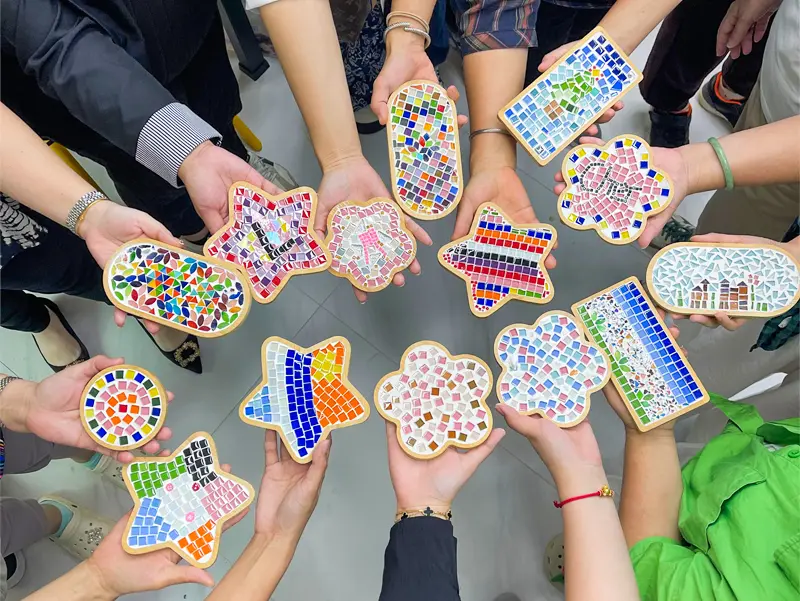

My daughter is 8 years old. Last Saturday, we sat down together at an art studio session and were both given a blank canvas. Ninety minutes later, she was holding up something that looked — and I say this with complete honesty — like it belonged in a café. I was holding up something that looked like the canvas had tripped and fallen into some paint. She studied mine for a long moment. Then, with the particular mercy that only small children can deliver, she said: "Don't worry, Papa. You tried your best."
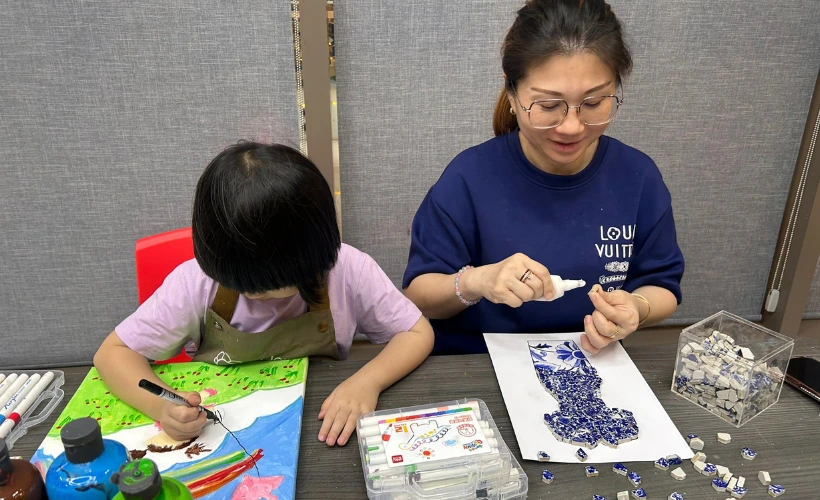
If you have a child who is even mildly interested in art, you probably know this moment. The moment you realised your 7-year-old's drawing of a cat looks more like an actual cat than yours does. The moment you watched your Primary 3 daughter mix paint colours with the casual confidence of someone who has been doing this for decades. The moment your son corrected your brushwork — gently, but still — and your brushwork definitely needed correcting.
This is a safe space. You can admit it. Your child is better at art than you. Probably has been for a while. And the more you try to hide this fact, the more obvious it becomes.
Stage 1 — Denial. Your child brings home a painting from school. It's vivid, expressive, and compositionally interesting. You tell yourself it's the teacher's guidance. Or the nice paper they use at school. Or the fact that children have naturally steady hands. Not that your child is just... better at this than you are.
Stage 2 — Rationalisation. You sit down to draw something together. Their horse looks like a horse. Yours looks like a horse that has been through something difficult. You explain that you're "out of practice." This is technically true in the sense that you last practised in Primary 4.
Stage 3 — The Compliment That Stings. Your child looks at your painting and says something kind. This is somehow worse than if they'd said nothing. "I like your colours" means they couldn't find anything else to praise. "You're getting better!" means they've been tracking your progress. "It looks interesting" means they're being diplomatic, and your 8-year-old is being diplomatic about your art.
Stage 4 — Acceptance. You are at an art studio on a Saturday morning, seated next to a child who is producing something beautiful while you produce something that could generously be described as "abstract," and you have made peace with this. In fact, you've started to wonder what you can learn from watching them.
I sit down at a canvas and immediately need to know: What am I painting? What style? What colours? What if it goes wrong? By the time I've planned everything, my child has already painted something and is considering what to add next. They have no plan and produce something with genuine visual coherence. I have a plan and produce something that looks like the plan was abandoned halfway through. I do not understand how this works.
My child will put bright orange next to hot pink next to electric green and it will look intentional. I choose colours that I know go together because I googled "what colours go together" before sitting down, and my painting looks like it was produced by someone who googled "what colours go together" before sitting down. Safe. Correct. Forgettable. Her painting looks like she was just living her life and colour happened to her.
A brushstroke lands wrong. The paint bleeds outside the line she intended. She pauses for less than one second, then adds something that makes the accident look like a decision. I make a similar mistake and spend seven minutes trying to paint over it, which creates a lumpy patch that now looks like a small hill that wasn't supposed to be there. Her painting has no regrets. Mine has a hill.
There comes a moment when my daughter puts down her brush and says "done." And she's right — the painting is done. It doesn't need anything else. I cannot do this. I add one more thing, then another, then another, and then I've over-worked it into a muddy, confused version of what it was before. The artistic concept of "knowing when to stop" is apparently not something you learn in adulthood. It is something 8-year-olds simply possess.
This is the biggest one. My child holds up her painting and shows it to everyone in the studio with the complete confidence of someone who knows they've made something wonderful. She's not performing. She genuinely, straightforwardly believes she has done a good thing, and she wants to share it. I slide my painting quietly into my bag and hope nobody asks to see it. The difference in our relationship to our own creative output is so vast it's almost funny. Actually, it is funny. It's also a little bit sad.
Here's where the confession stops being funny and starts being true.
The research on creative confidence from early childhood educators at NAEYC is consistent: young children approach creative tasks with a confidence that progressively erodes as they get older and more self-conscious. Watching your child create fearlessly is a reminder that this fearlessness is the natural human default — it's the self-consciousness that's learned. Which means it can, theoretically, be unlearned.
My child produces better art than me partly because she doesn't know what "bad art" looks like — she has no internal critic yet. I produce worse art than her partly because I have an extremely active internal critic who trained extensively under Singapore's school grading system and has not taken a day off since 1997. Being outclassed by your child at art is humbling in the most useful possible way. It forces you to sit with the discomfort of making something imperfect, in public, for no grade. Which is exactly the experience we're always asking our children to be brave enough to have.
I came to this realisation somewhere around the third time my daughter corrected my colour mixing with the patient authority of someone explaining something obvious to someone slower than themselves. The point of sitting down at a canvas together is not that either of us produces something beautiful. The point is the ninety minutes of sitting beside each other, making decisions, occasionally talking, occasionally not talking, and both being completely absorbed in the same activity. She will not remember what I painted. She will remember that I was there, painting badly, right next to her.
Nothing. That's the answer. You do not need to improve your art. You do not need to take classes to catch up. You do not need to watch YouTube tutorials on colour theory at midnight before the next Saturday session so you can hold your own against a child who has been drawing for four years.
You sit down. You pick up a brush. You make something imperfect and slightly unintentional. You let your child see that the adults in their life are also beginners at some things — and that being a beginner doesn't stop you from trying, or from showing up, or from having a genuinely good time regardless of the result.
The child who watches a parent create imperfectly and cheerfully learns something more valuable than anything a curriculum can teach: that creativity is not about talent. It is about showing up. It is about not putting your painting in your bag when you think nobody's looking.
A note on where to go from here: Art Journey's family art jamming sessions are specifically designed for exactly this dynamic — parents and children creating side by side, no skill requirement, no comparison, no grades. There are no prizes for best painting and no marks on the canvas. Just two people, two brushes, and ninety minutes of making something together. Your child will probably be better than you. That is fine. That is, in fact, the whole point.
For ideas on how to extend this creative practice into your home, see our home art corner setup guide — which costs less than one enrichment session and means your child can outclass you in the comfort of your own living room, daily.
Family art jamming and parent-child workshops at Art Journey. No skill required — for either of you. Open daily 10am–9pm. Bring your worst painting energy. Your child will bring theirs, which is much better.
Book a Family SessionCompletely normal — and arguably expected. Young children approach creative tasks with fearlessness and zero self-consciousness, which produces bold, confident work. Most adults carry years of "this isn't good enough" conditioning from school grades and social comparison. The result is that an 8-year-old who has never worried about whether her painting looks right will frequently produce more visually alive work than an adult who is thinking very hard about whether they're doing it correctly.
You don't need to. Being visibly imperfect at something alongside your child is actually one of the most valuable things you can model — it demonstrates that adults are also beginners at some things, that trying matters more than succeeding, and that creative activity is worth doing regardless of the result. Your willingness to sit down and paint something wobbly next to your child is more educational than anything they'll take from the painting itself.
Children haven't yet developed the inner critic that adults carry — the voice that compares, judges, and finds the work insufficient. Research in early childhood education consistently shows that young children's creative fearlessness is their natural state, which gradually erodes as they receive more external feedback and social comparison. This is part of why preserving a low-pressure, no-grade creative environment matters so much during childhood.
Enormously. Children who see their parents engage in creative activities — imperfectly, without embarrassment — are more likely to approach their own creative work without fear of failure. When a child sees an adult try something they're bad at and enjoy it anyway, it recalibrates their understanding of what creative activity is for. It's for the experience, not the result. That's one of the hardest lessons to teach, and the easiest to demonstrate.
Yes — that's specifically who they're designed for. No prior skill, no technique requirement, and no judgement on the finished piece. Parents who haven't touched a paintbrush since school are exactly as welcome as those who have. The session is about the experience of creating together, not about producing impressive work. Which is perhaps best demonstrated by the fact that a significant number of children at Art Journey sessions produce work that is objectively better than their parents'. This is celebrated, not awkward.
The same thing you'd want them to say to you: "That's really good. Tell me about it." Ask about their choices — the colours, the subject, what they were thinking when they painted a particular section. Children respond to genuine curiosity about their creative decisions. And if they ask about yours, tell them honestly what you were trying to do, even if the result doesn't quite match the intention. That gap between intention and result is something children and adults navigate together, which is the whole point.