











Remembering Yayoi Kusama: The Polka Dot Queen Who Taught Our Children That Imagination Has No Limits
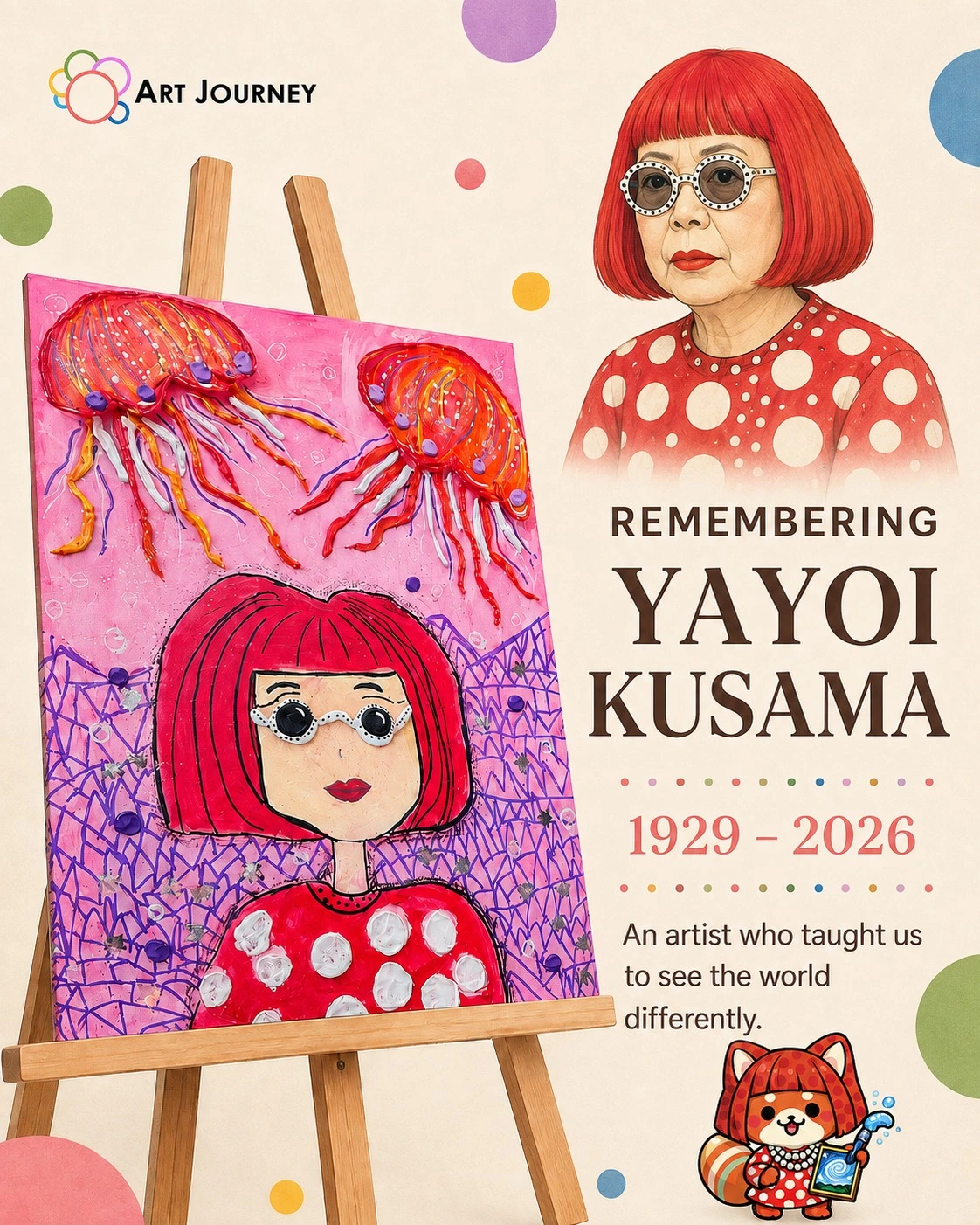
She turned dots into universes and pumpkins into poetry. On 14 August 2026, Yayoi Kusama passed away in Tokyo at the age of 97 — but in our studio in Tengah, her dots are still travelling.
Most of our children have never heard the name Yayoi Kusama. But almost every one of them knows the yellow pumpkin with black dots. They know the mirror room that goes on forever. They know that if you cover something in enough dots, it stops being an ordinary thing and starts being yours.
That was her gift. And it belonged to children long before it belonged to museums.
The Artist the World Just Lost
On 26 August 2026, Yayoi Kusama's studio announced that she had passed away at a Tokyo hospital on 14 August. She was 97. Her representatives said she was painting right up to her final days, never putting down the brush.
She was born in Matsumoto, Japan, in 1929, into a family that did not want her to be an artist. She had visual hallucinations from childhood — fields of dots that spread across walls, ceilings, and eventually across her own hands. She has said, in many interviews over the decades, that painting the dots was how she survived them. It was not decoration. It was how she made peace with a mind that would not stay quiet.
In her late twenties she moved to New York with a suitcase of drawings and almost no money, and spent years being overlooked in a scene run by men. In the early 1970s she returned to Japan and voluntarily checked herself into a psychiatric hospital, where she lived for the rest of her life. She kept a studio across the street. She walked to work every morning and painted.
She became one of the most visited artists on earth. Her Infinity Mirror Rooms drew queues around the world. Her pumpkins sold for millions. She designed for Louis Vuitton. And she did all of it while living in psychiatric care, in her eighties and nineties, in a red bobbed wig, insisting that art was not her career but her medicine.
She did not become famous despite being different.
She became unforgettable because of it.
Singapore Knew Her Before Most of Asia Did
If you were living in Singapore in 2017, you probably remember the queues. National Gallery Singapore hosted YAYOI KUSAMA: Life is the Heart of a Rainbow from 9 June to 3 September 2017 — over 120 works, and the first major museum survey of her career anywhere in Southeast Asia.
The pillars outside were wrapped in red and white dots. Timed-entry tickets were introduced because the crowds were unmanageable otherwise. Inside were the infinity mirror rooms, the pumpkin sculptures, and Narcissus Garden — 1,500 mirrored steel balls filling the City Hall Chamber.
What we remember most, though, is who was in those queues. It was not only the art crowd. It was families. Grandmothers with toddlers. Primary school kids who had been dragged along and then refused to leave the mirror room. That exhibition did something rare in Singapore: it made contemporary art feel like something a six-year-old was allowed to love.
Nearly a decade later, that is still true. Ask a child in Singapore to draw "a Kusama" and most will start dotting immediately. No instruction needed.
The Term We Spent Inside Her World
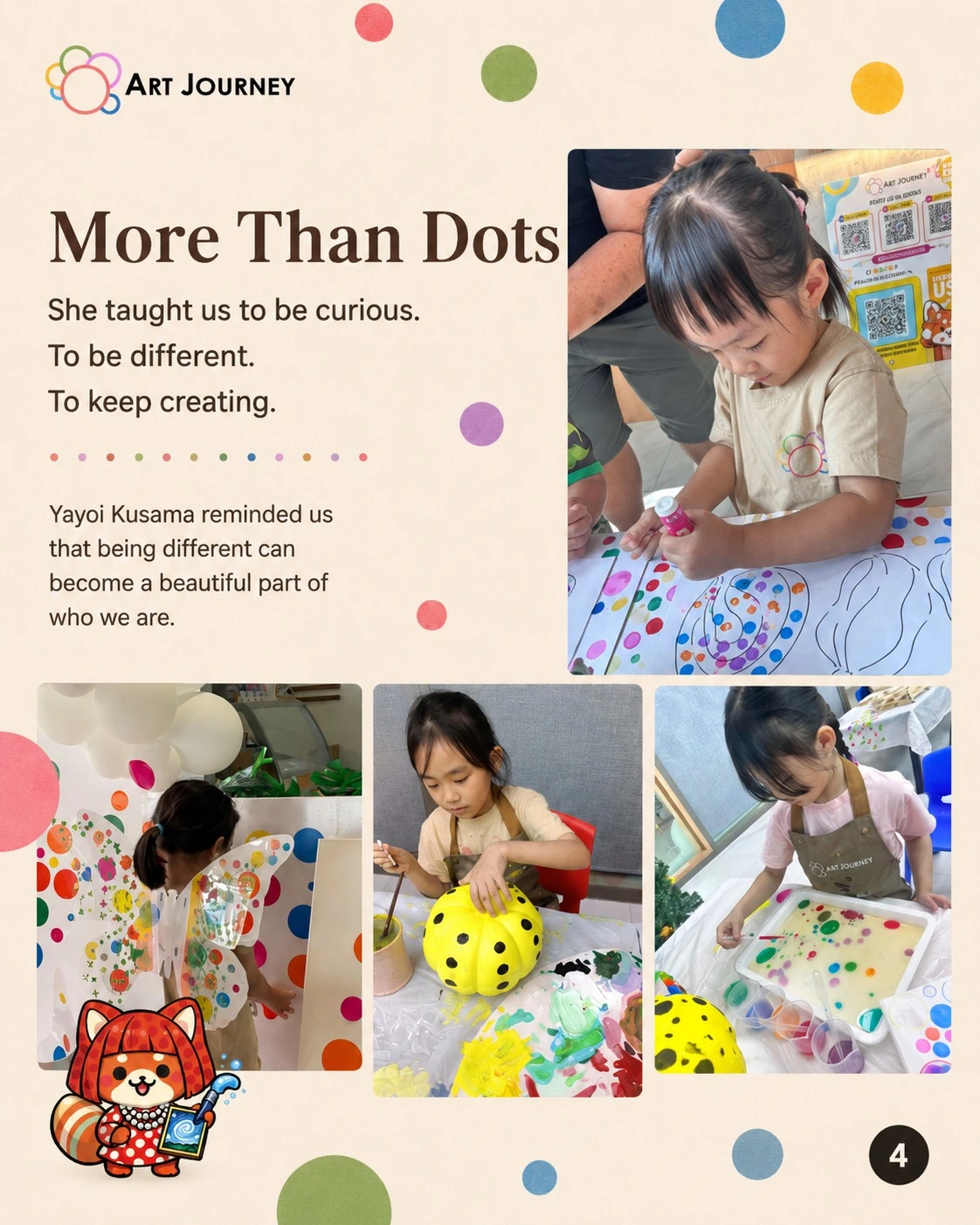
At our Plantation Plaza studio, we ran a Kusama-inspired series that turned into one of the most joyful stretches of work we have ever documented. We did not teach it as art history. We handed out dot stickers, cotton buds, bottle caps and paint, and let the children find their own way in.
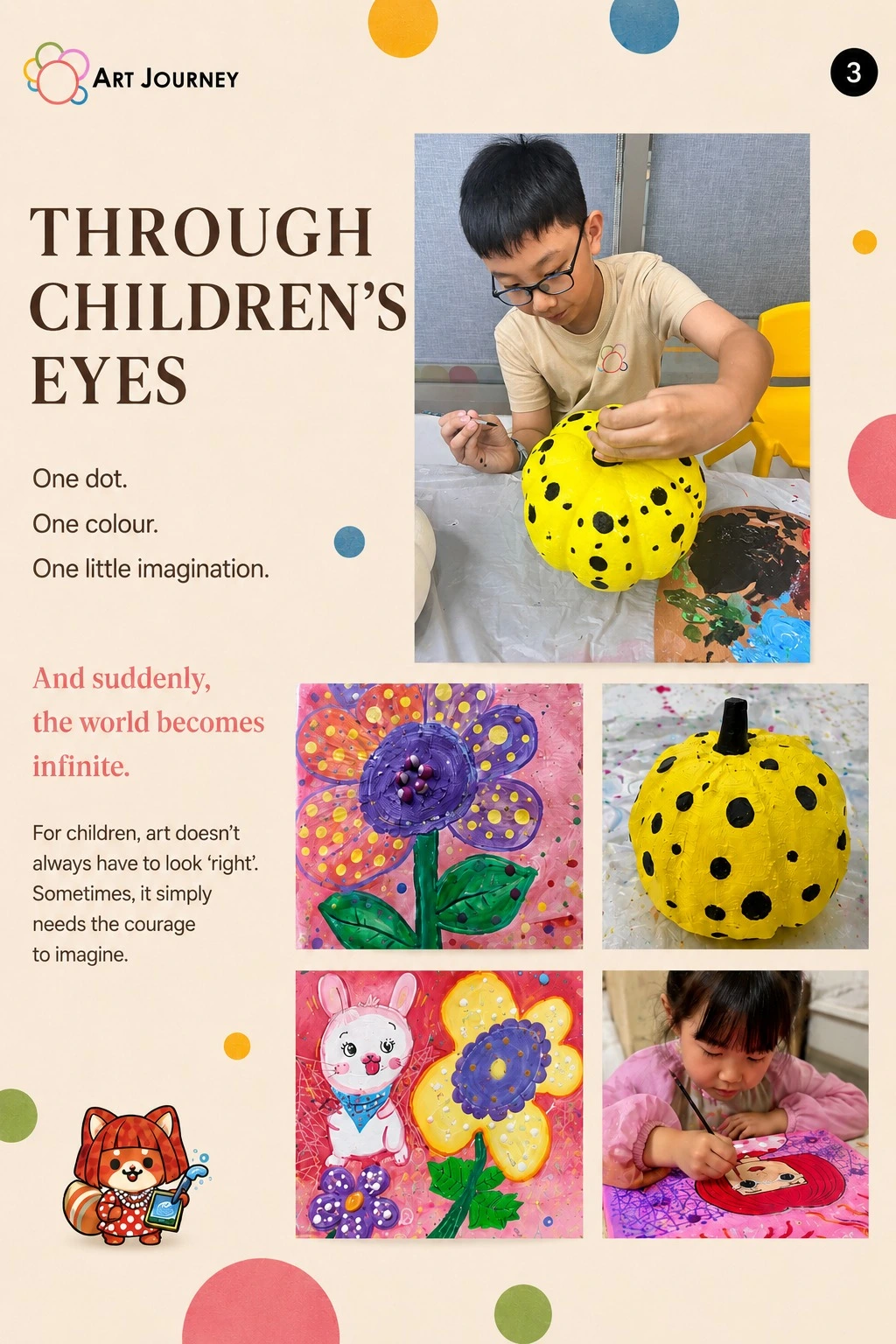
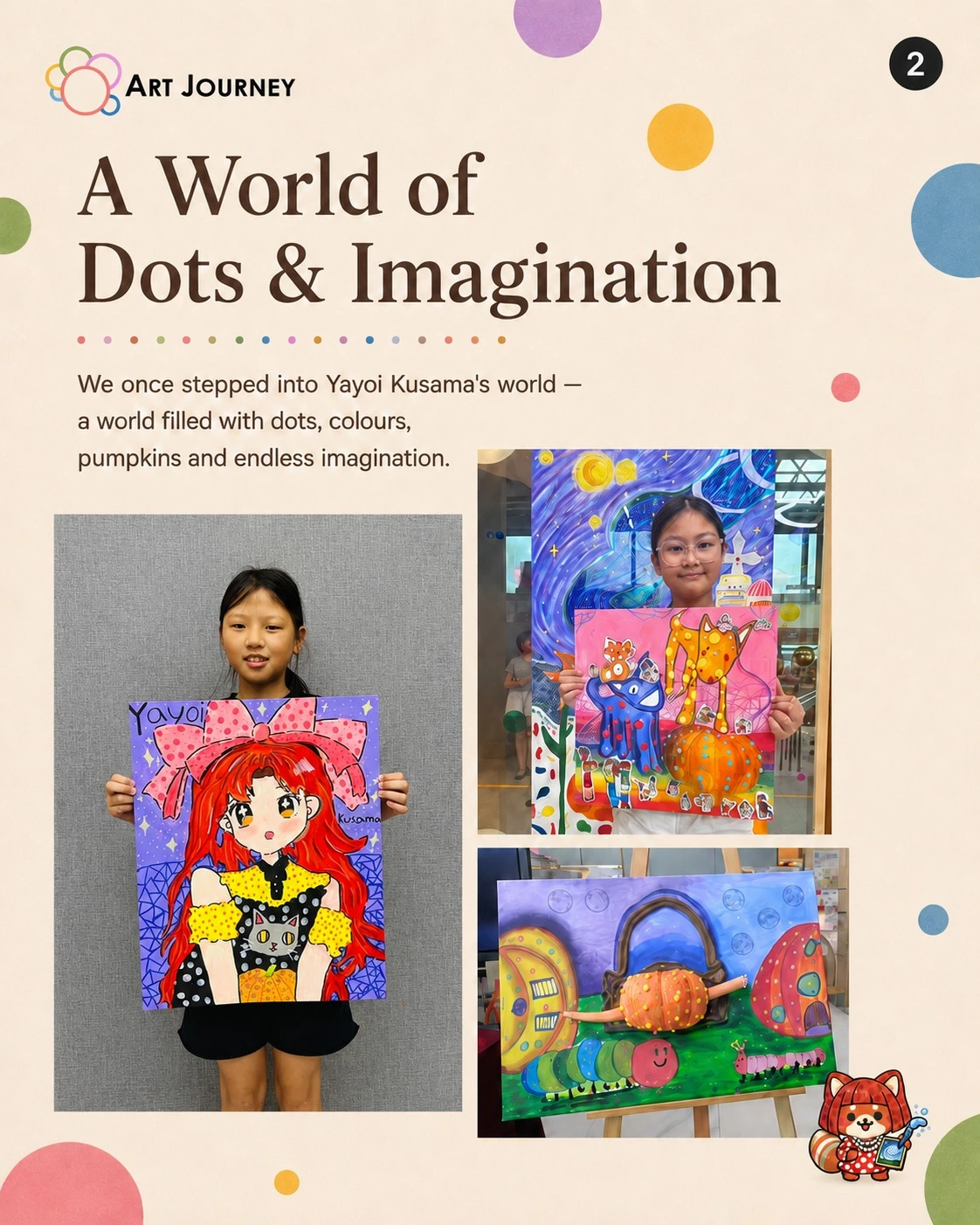
Our Kusama-inspired sessions at Art Journey, Plantation Plaza. Photos: Art Journey Singapore.
Here is what surprised us. The dot is the most forgiving mark in art. A child who is terrified of drawing a face will happily make four hundred dots. There is no wrong dot. And somewhere around dot number sixty, something shifts — the child stops checking whether it looks right and starts deciding where the next one goes because they want it there.
We watched three-year-olds who had never held a brush confidently cover an entire pumpkin. We watched a boy in Primary 3, who told us on day one that he "can't draw," spend forty minutes on the black spots of a yellow pumpkin and then ask to bring it home before it had dried.
By the end we had a full display outside the studio: dotted pumpkins, jellyfish canvases, red-haired portraits, mushroom landscapes, a dot-covered butterfly wing installation the children walked through. Parents stopped in the corridor to take photographs. Several told us they had brought their child to the National Gallery show in 2017 and never expected to see it come back around like this.
Six Things Kusama Teaches Children Better Than Any Syllabus
Repetition is not boring — it is meditative
Singapore children are trained to finish fast. Kusama's work asks for the opposite: stay with one mark, do it again, and again. Children who normally cannot sit for ten minutes will dot for forty.
There is no "correct" version
A dot cannot be badly drawn. That single fact removes the biggest barrier we see in children aged 6 and up — the fear of the first mark. Once that fear goes, everything else becomes possible.
Being different can be your best quality
Kusama's difference was not a charming quirk. It was a genuine mental illness that she never hid and never apologised for. She built seventy years of work directly out of the thing that made her unlike everyone else.
Ordinary objects deserve attention
She chose the pumpkin — squat, lumpy, unglamorous. She said she found pumpkins humorous and warm. Children immediately understand this logic. A pumpkin, a shoe, a lunchbox can all become art if you look at it long enough.
Art is allowed to be a feeling, not a skill
Her dots were how she managed anxiety. Many of our children arrive after a long school week carrying more than they can name. Giving them a repetitive, absorbing task is not a substitute for support — but it is a real release, and they feel it.
You are never too old to keep starting
She was still producing major new paintings in her nineties. When a child asks whether it is "too late" to be good at something, she is the answer.
Try It This Weekend: Kusama at Home
You do not need supplies from an art shop. Everything below works with what is already in a Singapore HDB flat.
Ages 3–6
- Cotton bud dots. Cotton buds, poster paint, any paper. Let them cover the whole sheet. No outlines, no subject.
- Dot a real object. An old plastic container or a paper cup, covered in round stickers. Instant sculpture.
- Sticker faces. Draw a simple face outline, hand over a sheet of dot stickers, walk away.
- Bottle cap printing. Dip the cap of a milk bottle in paint and stamp. Perfect circles, zero pressure.
Ages 7–12
- Two-colour rule. Yellow and black only, like her pumpkins. Constraints make older children more inventive, not less.
- Infinity room in a shoebox. Line a shoebox with foil or cheap mirror sheets, add fairy lights, cut a peephole.
- Obliteration wall. Tape white paper across a wall, give the whole family dot stickers, add to it over a week.
- Dot self-portrait. Trace their own face outline, then fill everything except the eyes with pattern.
One rule for parents: do not correct spacing. The moment you say "spread them out more evenly," it stops being their work. If you want to understand more about reading what your child produces rather than fixing it, we wrote about that in what your child's artwork actually tells you about how they're feeling.
Why This Approach Suits Some Children Better
Kusama-style work sits naturally with how we teach at Art Journey, and it is worth being honest that this is not the only valid approach to art education.
Traditional art learning
- Structured, syllabus-based progression
- Technique-focused and teacher-led
- Fixed schedule, step-by-step learning
- Focus on skill improvement over time
- Usually better suited to older children (7+)
- Classroom-style, structured environment
The Art Journey experience
- Theme-based creative exploration, drawing on Piaget, Montessori and Reggio-inspired thinking
- Hands-on and imagination-driven — "Dare to Draw, Dare to Express"
- Flexible sessions, join any time
- Wide range of materials: clay, tin foil, mosaic, mixed media
- Every two sessions produces a completed artwork
- Suitable from 3 years old
- Relaxed, playful, confidence-building
- Encourages observation of detail and creative thinking
Neither is better. A child aiming at a specific technical outcome may thrive in a structured programme. A child who has decided they "cannot draw" usually needs the other thing first — permission, materials, and no grading.
⭐ Kusama-Inspired Sessions at Art Journey
Our dot and pumpkin sessions run as part of our themed workshop rotation at Plantation Plaza, Tengah. Young Creator (ages 4–7) works with cotton buds, stickers, cardboard pumpkins and foil; Emerging Artist (ages 8–12) works on canvas with mixed media and builds their own mirror-box installation.
They are also one of our most requested art jamming themes for families and for birthday parties, because the dot format lets a three-year-old and a grandmother work on the same canvas without either feeling out of place. You can see the full range on our kids art workshops page, or read about how the studio works on our homepage.
What We Tell the Children
When we explained that she had passed away, one of our younger students asked whether that meant the dots would stop.
The honest answer is no. An artist's life ends. Imagination does not. Every time a child picks up a brush, mixes a colour they were not taught to mix, makes a dot and then decides where the next one goes — the work continues. It was never really about her. It was about giving people permission.
Thank you, Yayoi Kusama.
Your dots will keep travelling — from one generation to the next.
Frequently Asked Questions
Yayoi Kusama passed away on 14 August 2026 at a hospital in Tokyo, at the age of 97. Her studio made the announcement publicly on 26 August 2026. She was born in Matsumoto, Japan, on 22 March 1929, and reportedly continued painting until her final days.
Because her signature mark — the dot — cannot be done wrong. That removes the fear of the first mark, which is the biggest obstacle we see in children from about age six onwards. Her work is also visually bold and immediately recognisable, so children engage with it without needing any art history background. Children as young as three can produce something they are genuinely proud of in one sitting.
Yes. National Gallery Singapore presented YAYOI KUSAMA: Life is the Heart of a Rainbow from 9 June to 3 September 2017 — her first major museum survey in Southeast Asia, featuring over 120 works including infinity mirror rooms, pumpkin sculptures and the Narcissus Garden installation. It was a collaboration with Queensland Art Gallery | Gallery of Modern Art in Brisbane, and drew crowds large enough that timed-entry ticketing was required.
Keep it simple and non-frightening. Something like: "Her brain showed her things that other people couldn't see, and sometimes that was scary for her. So she painted them. That's how she felt better, and that's how she became one of the most famous artists in the world." Most children accept this easily, and for children who feel different themselves, it can land as genuine reassurance. There is no need to go into clinical detail.
Almost nothing you'd need to buy specially. Cotton buds, poster or acrylic paint, round stickers from any bookshop, bottle caps for stamping, and paper. For older children, aluminium foil and a shoebox will make a workable mini mirror room. Yellow and black paint alone is enough for pumpkin work — the two-colour limit tends to produce better results than a full palette.
Yes. Dot and pumpkin themes appear in our themed workshop rotation at our Plantation Plaza studio in Tengah, for both Young Creator (ages 4–7) and Emerging Artist (ages 8–12) groups. They're also available as an art jamming theme for families, birthday parties and group bookings, since the format works across a wide age range in the same session. WhatsApp us to check current dates and availability.
Let Your Child Find Their Own Dot
No grading. No pressure. Just materials, space, and a child deciding for themselves where the next mark goes. Drop into our studio at Plantation Plaza, Tengah — open daily, 10am to 9pm.
Photographs in this article are original images taken at Art Journey Singapore, 127 Plantation Crescent #04-07 Plantation Plaza, Singapore 690127. Artworks shown are original pieces created by our students, inspired by — not reproductions of — the work of Yayoi Kusama. Exhibition details referenced from National Gallery Singapore. All rights to Yayoi Kusama's original artworks remain with the Yayoi Kusama Estate.