
















In September and October each year, thousands of Singapore families quietly reorganise themselves around a single event: the PSLE. The P6 child at the centre of it gets the tuition, the emotional attention, the special breakfasts, the "let's not disturb her" whispers. What almost nobody talks about is the other child in the same house — the Primary 3 sister, the Primary 5 brother, the secondary school sibling home for the day — who watches all of this from the edges and quietly disappears from the family's attention for six to twelve months. This blog is for that child. And for the parent who knows, deep down, that something isn't quite right and doesn't have the time or bandwidth to fix it.
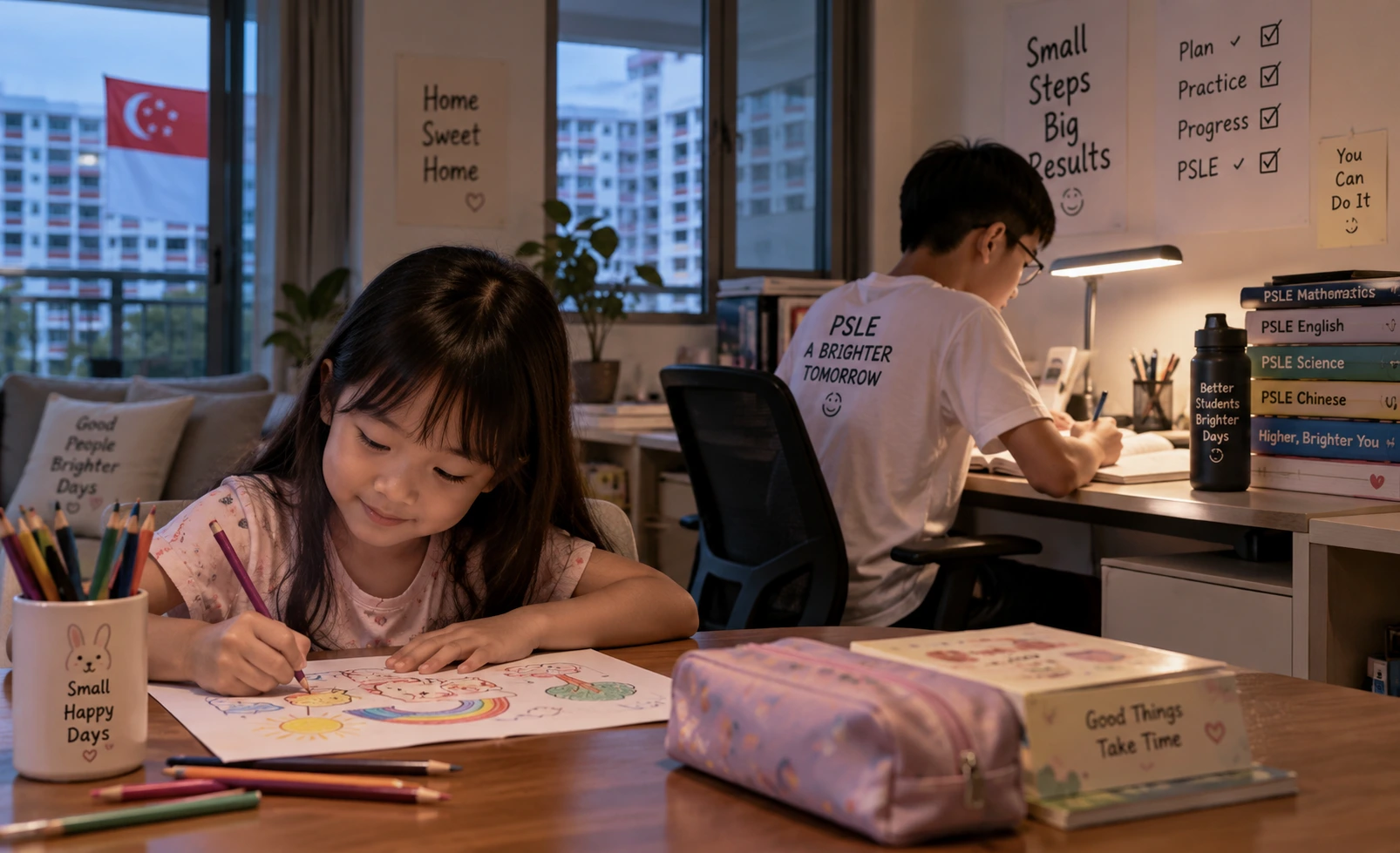
If you are a Singapore parent with more than one child, and one of them is in Primary 6, you already know what this blog is about. You have almost certainly caught yourself doing one of the following in the past few weeks:
- Saying "not now" to your younger child for the fourth time in a day because you were quizzing your P6 on maths
- Cancelling your usual family activity because there's a mock paper this weekend
- Realising that your younger child has stopped asking you to play — because they have quietly learned the answer will be no
- Feeling a wave of guilt that arrives at 10pm when the house is finally quiet, and being too tired to do anything about it
This is not a failure of parenting. It is a structural feature of Singapore's education system. The PSLE genuinely does require enormous parental attention for six to twelve months. Something has to give — and what usually gives is the time, energy, and emotional presence available for every other child in the household. The problem isn't that this happens. The problem is that most parents don't have a plan for it, which means the sibling on the sidelines quietly absorbs the cost without anyone noticing until it's too late.
The dynamics are remarkably consistent across families. Some patterns you may already be noticing — or that you might now recognise in hindsight from a previous PSLE year:
The younger sibling stops asking for things. They no longer request weekend outings, playdates, or your time. This isn't maturity — it's an adaptive response to repeatedly being told "not now." A child who stops asking is a child whose needs have gone underground, not disappeared.
Some children start acting younger than their age — clinging, whining, wanting to be carried again, refusing to sleep alone. Others go the opposite direction and withdraw completely — spending more time on screens, in their room, or with friends' families. Both are the same signal in different forms: I need more attention than I'm getting.
The sibling starts making pointed remarks about the older child — "she gets everything," "why is his mock paper more important than my school concert?" — sometimes overt, sometimes muttered. This isn't about the PSLE. It's about the sibling processing a loss of parental attention through the only lens they can name.
A P3 or P4 child watches a full year of family stress orbit around one exam. Without meaning to, they start dreading their own PSLE — three to five years in advance. Parents sometimes discover this only when the younger child, still in lower primary, starts asking anxious questions about "what happens if I don't do well."
Some siblings start achieving intensely — bringing home spelling test results at the same volume the PSLE child's mock papers get discussed at. Others act out at school, get into trouble, or start "having problems" that require parent meetings. Both are attempts to be seen. Neither is manipulative. Both are healthy signals from a child who has run out of other ways to say I'm still here.
Not every sibling shows all of these signs. Most show one or two. If you're recognising any of them, you're not a bad parent — you're a parent whose attention has been legitimately consumed by one child's genuine need. The next question is what to do about it, without adding another impossible task to your already overloaded PSLE-season schedule.
The following are chosen deliberately for one criterion: they add almost nothing to your existing parental load. A PSLE-season parent does not have time or energy for a new elaborate system. These are practical, small, and repeatable — and they work.
Not 15 minutes in the middle of the family space where the P6 child can interrupt. Fifteen minutes with the door closed, phone on silent, and one instruction to the rest of the household: "Do not disturb us." Read together. Play a card game. Or simply lie on the bed and ask about their day. The activity matters less than the exclusivity. The child receiving those 15 minutes knows something the rest of the house doesn't: right now, they are the entire focus of one parent's attention.
The house during PSLE season is a stressful place. Even a well-managed household carries a low-grade tension the sibling absorbs constantly. Give them a place to go that is theirs — a fortnightly Saturday morning at an activity that has nothing to do with school, exams, or the PSLE-child's schedule. It could be a swim class, a library storytime, or an art workshop at Art Journey. What matters is that the ritual exists, they know it's coming, and it doesn't get cancelled every time the older sibling has a mock paper.
If both parents are involved in PSLE preparation, divide and conquer. One parent takes primary responsibility for the PSLE child during the intense final months. The other parent takes primary responsibility for the sibling. This isn't cold — it's realistic. The sibling gets consistent, dedicated attention from one parent even if the other is unavailable, which is significantly better than being everyone's second priority.

Children internalise everything they are not explicitly told. If your Primary 3 daughter has been quietly watching her brother receive all the attention for months, she has almost certainly concluded, at some level, that this is because he is more important than she is. The corrective is simple, brief, and needs to be said only once: "I know this year has been really unfair to you. Your brother is getting a lot of our attention right now because of PSLE, and that's temporary — it's not because he matters more than you do. You matter just as much. And once this is over, things will feel different."
Say this once, calmly, when the two of you are alone. Don't make a big deal of it. Don't repeat it constantly. Just make sure the message has been spoken out loud, so the child doesn't have to guess.
Singapore families often live in multi-generational or closely networked households. Use it. A grandparent who takes the sibling out for lunch once a week — just the two of them — provides exactly the dedicated attention the child needs, without adding to your load. Do not treat this as childcare. Frame it as a special relationship: "Your Ah Ma really wants to spend proper time with you this year." Most grandparents will jump at the opportunity, and the sibling gets an adult who is fully theirs for a few hours a week.
Look at your younger child's schedule right now. Identify the one activity, class, or ritual they genuinely love. Then make a private commitment: this one thing does not get cancelled, no matter what happens with PSLE. If it's their swimming class on Sundays, protect it. If it's Friday movie night, protect it. If it's the fortnightly art session where they finally get to make something with their own hands, protect it. The rest of their life can bend around the PSLE. This one thing does not.
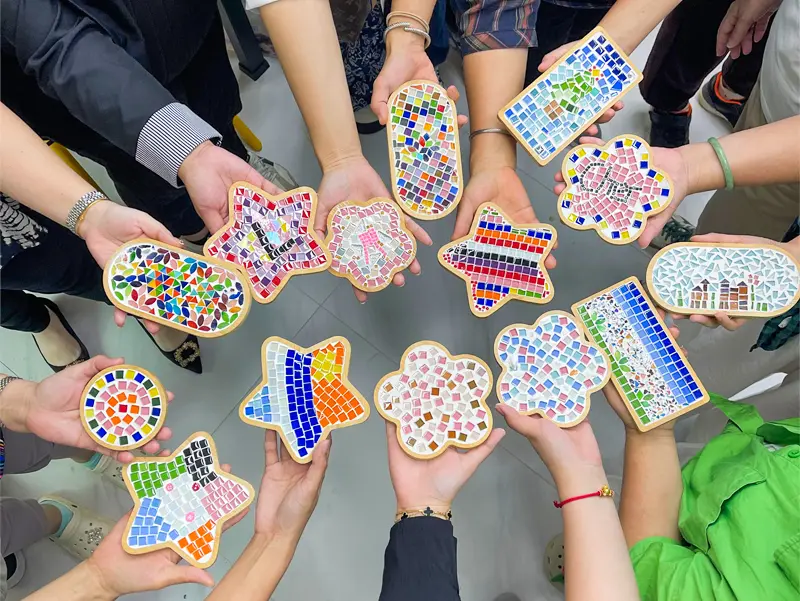
Of all the possible "sibling's own thing" you could choose during PSLE season, creative activities have a specific advantage that most other options don't share. They are one of the few contexts in which a child gets to be the maker, the decider, and the one whose choices matter — none of which they experience much during a PSLE year in the family home.
A child sitting at a canvas making their own painting is not being compared to their older sibling. Not being asked how they did on their spelling test. Not being told to be quiet because someone is studying. They are the centre of the activity, the one whose colour choices matter, the one whose finished piece is genuinely theirs. For a child who has spent months feeling secondary, ninety minutes of feeling primary again is not a small thing.
Art Journey's model — no term commitment, no fixed weekly slot, book by the session — is specifically well-suited to the chaos of PSLE year scheduling. You don't need to lock into a term. You don't need to commit to every Saturday. You book when the week allows, and the sibling has a reliable creative outlet that doesn't add another rigid appointment to your already impossible calendar. For a PSLE-season parent, that flexibility is the whole point.
A note on cost and effort: A single Art Journey session — booked once a fortnight for the six months around PSLE — is one of the highest-return, lowest-effort things a Singapore parent can do for their sibling child. You are not adding a permanent commitment. You are not managing another schedule. You are simply outsourcing 90 minutes of dedicated, creative, personal attention to a studio while you focus on what you need to focus on. And your sibling child gets what they've been quietly missing all year.
When PSLE finishes in early October, most families exhale collectively — and the parents' attention snaps back to normal. But the sibling has been quietly adapted for months. They may not immediately trust that things are back to normal. Some children continue to hold themselves at a distance for weeks after PSLE ends, waiting to see whether the pattern really has changed.
The reset conversation matters. Sit down with your sibling child in the week after PSLE and say something like: "That was a really long year for you. Thank you for being so patient. Let's do something that's just you and me next weekend — you pick." Then follow through. The child needs both the acknowledgement and the visible action. Both are what tell them the season has ended.
For more on how families can rebuild together after the intensity of PSLE season — including the older child's recovery — see our companion guide on PSLE recovery activities for the whole family. And if you're navigating broader questions about how to fit creative activities into a Singapore family's already-packed schedule, our guide on the enrichment guilt spiral offers a framework for doing less, better.
A single Art Journey session — booked when your week allows — gives the sibling of a PSLE candidate 90 minutes of undivided creative attention. No term commitment. No fixed slot. Just their turn to be the centre of the activity. Open daily 10am–9pm at Plantation Plaza, Singapore.
Book a SessionYounger siblings of a PSLE candidate typically experience six to twelve months of significantly reduced parental attention, cancelled family activities, and household tension. Common signs include learned quietness (they stop asking for things), regression or withdrawal, resentment toward the PSLE sibling, early PSLE anxiety, or attention-seeking behaviour. These are normal, healthy responses to a real change in the family — not signs of a problem with the child.
Focus on small, sustainable actions rather than elaborate systems. Give them 15 minutes of exclusive attention daily. Protect one weekend activity they love from being cancelled. Involve grandparents or trusted family members for regular one-on-one time. Say out loud, once, that you see the situation is unfair and that it's temporary. And give them a fortnightly ritual outside the house — an art session, swim class, or library visit — that belongs only to them.
Acting out during a PSLE year is almost always a signal that the sibling needs attention and is running out of other ways to ask for it. It's rarely about the specific behaviour — it's about being seen. The most effective response is usually not disciplinary but relational: identify one dedicated ritual that gives them consistent one-on-one attention, and the acting out typically reduces within a few weeks.
The imbalance of attention during PSLE season is a structural feature of Singapore's education system — not a personal parenting failure. What matters is not whether the imbalance exists (it will), but whether you have a small, deliberate plan for the sibling during the intense months. A weekly 15-minute ritual, one protected weekend activity, and a single honest conversation are usually enough to significantly reduce the developmental cost to the sibling.
Art workshops give the sibling ninety minutes of being the maker, the decider, and the one whose choices matter — none of which they experience much at home during a PSLE year. Art Journey's session-based model (no term commitment, book when the week allows) is particularly well-suited to the chaos of PSLE-year scheduling, because it doesn't add a rigid weekly appointment to an already overloaded family calendar.
Have a brief reset conversation in the week after PSLE. Acknowledge that the year has been unfair to them. Thank them for being patient. Then plan something visible and dedicated — a day out, a special activity, an outing that's genuinely theirs — and follow through. The sibling needs both the verbal acknowledgement and the visible action to trust that the season has ended and normal attention has resumed.
Younger siblings watching a full year of PSLE-related family stress often begin dreading their own PSLE years in advance. Address this directly and calmly: explain that PSLE is one exam, not a definition of their worth; that every family handles it differently; and that when their own year comes, you will have learned from this experience and it will be different. Reassure them that being anxious about it now, at Primary 3 or 4, is understandable but not necessary. Their PSLE year is far away, and a lot can change in Singapore's education system between now and then.