








By the time most Singapore children start Primary 1, a great deal of effort has gone into their reading, their numbers and their Chinese. Far less has gone into their hands. And yet the first term of P1 is relentlessly physical: copying from a whiteboard, writing for longer than they ever have, cutting and pasting into worksheets, and opening their own food in a recess that is shorter than it sounds. Nobody hands you a list for this part. Here is one — along with the thing about pencil grip that most parents are getting wrong.
Before any checklist is useful, it helps to be specific about what the demand actually is. A P1 classroom asks for things a preschool day rarely does — not harder versions of the same tasks, but different tasks, performed for longer, with less adult help, and on somebody else's timetable.
Most preschoolers can form letters. Fewer can keep forming them for twenty minutes without the hand tiring, the grip collapsing or the letters degrading down the page. Endurance is a separate skill from formation, and it's the one that shows up as "his handwriting gets worse near the end."
This is genuinely new. Copying from a book on the desk is one skill; looking up at a board several metres away, holding the information, looking down and reproducing it is another. It involves shifting focus, visual memory and motor output together, and plenty of otherwise capable children find the first weeks of it hard.
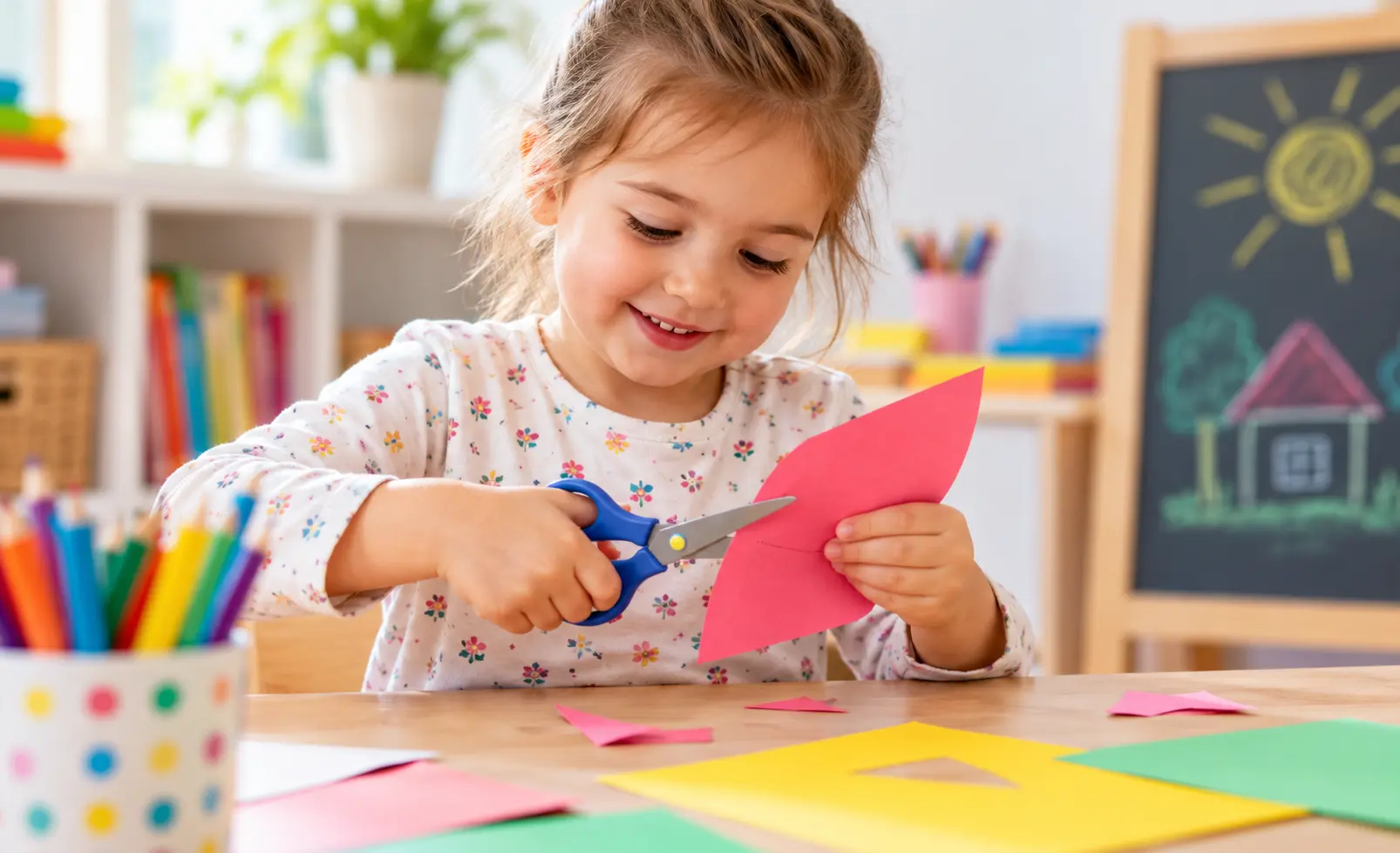
Cut-and-paste activities are standard in P1 worksheets, and they're done at the child's own pace with no adult holding the paper. A child who has always had scissors tasks pre-cut or supervised at home will be slower, and slower in a timed classroom task becomes unfinished work.
This is the one parents most consistently underestimate. Recess is short, the queue takes part of it, and a child who can't open their own packet, unscrew their own bottle or manage their own container doesn't eat. It isn't a fine motor curiosity — it's whether your child has lunch.
Zips, buttons, shoelaces or velcro, packing a bag, handling a file, getting a worksheet into the right folder. Each is small. Together they make up a surprising share of the day, and a child who struggles with them spends energy on logistics that other children spend on learning.
Worth noticing: none of the above is about artistic ability or neatness. They're about strength, endurance, coordination and independence. A child can draw beautifully and still find P1 physically tiring — and a child whose drawings look rough can be perfectly well equipped for it.
If you have been correcting your child's pencil grip — moving their fingers back into position, buying grip trainers, reminding them at every worksheet — there's something in the occupational therapy research worth knowing before you spend another term on it.
Occupational therapy research has long treated the dynamic tripod grip as the gold standard. But studies comparing it against other mature grips — the lateral tripod, the dynamic quadrupod and the lateral quadrupod — have repeatedly found no significant difference in handwriting legibility or speed between them. All four are classified in the literature as mature, functional grasp patterns.
One widely cited study published in the Australian Occupational Therapy Journal put it directly: the dynamic tripod offered no advantage over the other three after a ten-minute copying task, and the authors said their findings question the practice of having students adopt the dynamic tripod grip at all.
There's a second finding that matters just as much. Research on fine motor intervention has found that programmes can produce real, measurable gains in children's fine motor and visual motor skills while producing no significant change in grip pattern. In other words: grip is fairly resistant to being changed directly, and the underlying skills improve anyway.
The practical conclusion is uncomfortable for a lot of Singapore households: if your child's writing is legible, reasonably quick and comfortable, their grip is doing its job — even if it doesn't look like the diagram. Drilling a functional grip into a different functional grip is unlikely to change anything except how much both of you dread writing practice.
That said, this is not a licence to ignore grip entirely. Some grips genuinely are less functional — a fist grip well past toddlerhood, or a thumb wrapped over the fingers — because they limit the small finger movements writing needs and make the hand tire faster. The distinction isn't "textbook versus not." It's whether the grip allows controlled movement from the fingers, and whether the child can sustain it.
These ages are approximate ranges, not deadlines, and children vary considerably. For a fuller explanation of what different grasps look like, paediatric occupational therapist Kim Griffin's guide to pencil grasp is a clear, evidence-based reference.
Scissors are the clearest example of a readiness skill that develops in a genuine order — and the one most likely to have been skipped, because scissors are messy, slightly alarming and easy to avoid at home.
Single snips at the edge of a piece of paper. No travel, no line. The goal is simply the open-close motion with reasonable control.
Several snips in sequence to cut right across a narrow strip. The hand starts travelling forward while cutting, which is harder than it looks.
Staying on or near a drawn line. This is where the non-dominant hand becomes important — it has to feed and turn the paper, which is a coordination skill in itself.
Circles and squares. Curves require continuous paper rotation with one hand while cutting with the other, which is the real milestone here.
Cutting out a drawn figure with corners and curves, reasonably close to the line. This is roughly the level P1 cut-and-paste worksheets assume.
If your child is approaching P1 and hasn't done much cutting, the fix is straightforward and doesn't require a programme: give them child-safe scissors and things worth cutting. Old magazines, junk mail, cardboard packaging, paper chains, their own drawings. Volume matters more than instruction — a child who has cut a hundred things will be fine.
Hand strength and endurance. This is the foundation under everything else, and the hardest to build with worksheets — because worksheets exercise the skill without building the muscle. Strength comes from resistance: squeezing, pinching, pulling, squashing. Clay and dough, tearing paper, pegs, squeezing bottles, tongs, threading. Twenty minutes of clay does more for a tired writing hand than twenty minutes of tracing.
Bilateral coordination. Using two hands for different jobs at the same time — one holds and turns, the other cuts or writes. Most classroom tasks need it and almost nobody practises it deliberately. Cutting, threading, tearing, using a stapler, holding paper steady while writing, opening containers. If your child always stabilises paper with their chin or their elbow, this is the thing to look at.
Self-care under mild time pressure. Not whether your child can open their water bottle, but whether they can do it in a busy, noisy room within a few minutes without help. The gap between "can do it at home with Mum watching" and "can do it at recess" is real. Practise at home with the actual bottle, the actual container and the actual packaging they'll take to school — and then stop helping.
- Clay, dough, anything squeezed or pinched
- Scissors, in volume, on real materials
- Tearing and crumpling paper
- Threading, beading, pegs, tongs
- Construction toys and small blocks
- Drawing on a vertical surface — easel, wall-taped paper
- Cooking: stirring, kneading, spreading, pouring
- Doing up their own zips and buttons, daily
- Tracing worksheets in volume — exercises the skill, doesn't build the muscle
- Grip trainers, for a child whose grip is already functional
- Correcting finger position repeatedly
- Screen-based "fine motor" apps — a finger swipe is not a pinch
- Handwriting drills when the real issue is endurance or strength
- Buying a readiness programme before anyone has identified the gap
The pattern is simple enough: resistance and variety build hands; repetition of the end task does not. A child who struggles to write for twenty minutes needs stronger hands, not more writing.
Most children arrive at P1 with hands that are adequate and get stronger quickly once school demands it. But some things are worth raising rather than practising away at home: a grip that is still fisted or thumb-wrapped with no sign of changing, writing that is consistently painful or exhausting rather than just effortful, a child who avoids all fine motor tasks rather than finding them hard, or difficulty that sits alongside concerns in other areas of development.
Occupational therapists are the relevant profession here. In Singapore, the route is the same as for any developmental concern — start with a polyclinic doctor, a CHAS GP or your paediatrician, who can refer onward. Your child's preschool teacher is also worth asking directly: they see a lot of children of this age and will tell you honestly where yours sits.
Raising it early costs very little. P1 is a demanding year to discover a problem in.
We'll be straightforward, as we were in our guide on reading developmental milestones without panicking: we are not occupational therapists and we don't assess children. If something above genuinely concerns you, that's a conversation for a clinician, not a studio.
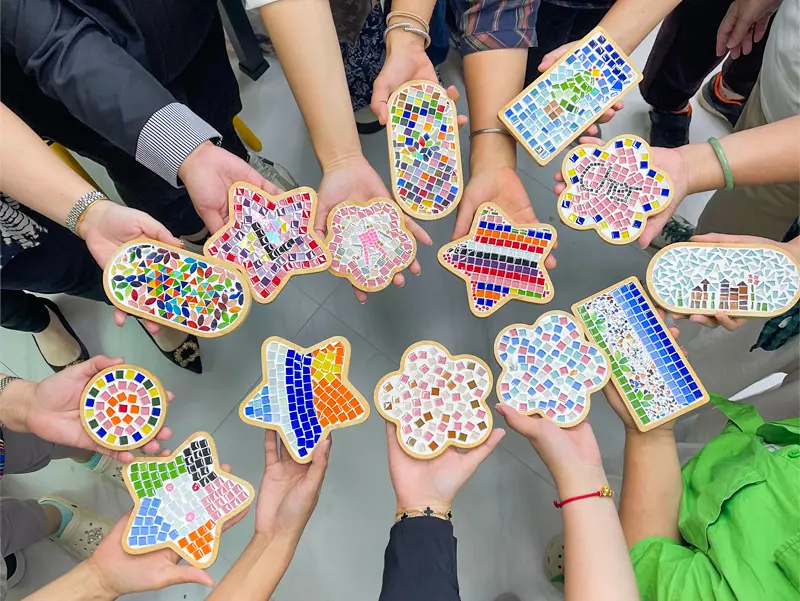
What we'd honestly say is narrower. Most of the activities in the left-hand column above are simply what an art session consists of — clay being squeezed, scissors being used on real materials, paper being torn, small pieces being placed, two hands doing different jobs for an hour at a stretch. None of that is designed as fine motor training and we wouldn't sell it as therapy. It's just that children who do a lot of making tend to have hands that have done a lot of work.
You can get the same effect at a kitchen table with a $2 pack of air-dry clay and a pair of child-safe scissors, and we'd rather say so than pretend otherwise. If you want the home version, our home art corner guide covers what's worth buying.
Not a readiness programme — just a session where hands do a lot of work and something gets made. Ages 4–12, single sessions, materials included, no term commitment. Open daily 10am–9pm at Plantation Plaza, Singapore.
Book a SessionNot in the way most parents assume. Occupational therapy research has found no significant difference in handwriting legibility or speed between four mature grasp patterns — the dynamic tripod, lateral tripod, dynamic quadrupod and lateral quadrupod. If your child's writing is legible, reasonably quick and comfortable, the grip is functional even if it doesn't match the textbook diagram. Grips that genuinely warrant attention are those limiting finger movement, such as a fist grip well past toddlerhood or a thumb wrapped over the fingers.
If the grip is one of the mature functional patterns, repeated correction is unlikely to improve anything and may make writing practice unpleasant for both of you. Research has also found that fine motor intervention programmes can produce real gains in underlying skills while producing no significant change in grip pattern — grip is fairly resistant to direct change. Focus instead on hand strength, endurance and whether writing is comfortable and sustainable.
Roughly, a child approaching P1 should be able to cut out a simple drawn shape with corners and curves reasonably close to the line — which is about the level P1 cut-and-paste worksheets assume. The developmental sequence runs from single snips, to cutting across a strip, to following a straight line, to simple shapes like circles, to more complex outlines. If your child hasn't done much cutting, volume fixes it faster than instruction: give them child-safe scissors and plenty of junk mail, magazines and packaging.
Beyond letter formation: writing endurance (keeping the hand working for twenty minutes without degrading), copying from a whiteboard at distance, cutting and pasting unassisted, bilateral coordination for tasks needing two hands doing different jobs, and self-care independence — opening their own food, bottle, zips and bag under mild time pressure. That last one matters more than parents expect, because a child who can't open their packet at a short recess doesn't eat.
They exercise the skill but do relatively little to build the underlying hand strength. Strength comes from resistance — squeezing, pinching, pulling and squashing. Clay and dough, tearing paper, threading, pegs and tongs do more for a tired writing hand than additional tracing. A child who struggles to write for twenty minutes usually needs stronger hands rather than more writing.
Consider raising it if your child's grip remains fisted or thumb-wrapped with no sign of changing, if writing is consistently painful or exhausting rather than merely effortful, if they avoid all fine motor tasks rather than finding them difficult, or if the difficulty sits alongside concerns in other developmental areas. In Singapore, start with a polyclinic doctor, CHAS GP or paediatrician, who can refer onward. Your child's preschool teacher is also worth asking, as they see many children of the same age.
Art sessions involve a lot of the activities that build hands — clay, scissors, tearing, placing small pieces, using two hands together for sustained periods. But they are not readiness programmes or therapy, and no studio should present them as such. Much of the same benefit is available at a kitchen table with air-dry clay and child-safe scissors. If you have a genuine concern about your child's fine motor development, that's a question for a clinician rather than a studio.