







Your child just turned 3, and you've seen them scribble on every available surface, smear paint across the table (and themselves), and show genuine delight at anything involving colour and mess. You're wondering: is it time to sign up for an art class? Or would it be too early — and end in tears, tantrums, or a wasted registration fee? This guide is for parents standing at that exact crossroads.

The short answer: most 3-year-olds are ready for some form of art experience. But "ready for art" doesn't mean "ready for a formal 90-minute drawing lesson." Understanding the difference — and knowing what to look for in a class — is what this guide covers.
Three-year-olds are in a fascinating developmental window. According to Jean Piaget's theory of cognitive development, children around this age are transitioning from the sensorimotor stage (learning through physical interaction) into the preoperational stage (thinking symbolically, using imagination, beginning pretend play). The organisation Zero to Three, one of the leading early childhood development resources globally, notes that children at this age learn primarily through sensory exploration — touching, squishing, mixing, and experimenting with materials.
In art terms, here's what that means practically:
- Hold a chunky crayon or thick brush — grip is palmar (whole fist), not precise pencil grip
- Make deliberate marks — circles, lines, dots, not just random scribbles
- Name their scribbles — "this is mummy" or "this is a dog" even if it looks nothing like it (this is symbolic thinking emerging)
- Enjoy sensory materials — paint, clay, sand, water, textured surfaces
- Show strong colour preferences — "I want the purple one"
- Focus on one activity for about 10–15 minutes before needing to move on
- Experience big emotions — excitement, frustration, possessiveness — all normal
Notice what's not on that list: drawing recognisable pictures, following multi-step instructions, sitting quietly for an hour, or producing anything "impressive." If you're expecting those things, you'll be disappointed — and so will your child. But if you reframe "ready for art" as "ready to explore, get messy, and discover" — then yes, most 3-year-olds are absolutely there.
Every child develops at their own pace. Here are some observable indicators that can help you decide:
- Happily plays with paint, crayons, or clay at home (even briefly)
- Can sit for 10–15 minutes on a single activity before moving on
- Shows interest in other children — watches them, plays alongside them
- Is comfortable in new environments after a few minutes of settling
- Enjoys sensory experiences — sand, water, dough, textures
- Can separate from a parent briefly (or does well with parent nearby)
- Shows excitement about colours, shapes, or making marks
- Gets very distressed in unfamiliar settings and doesn't settle
- Dislikes touching messy or textured materials
- Has strong separation anxiety that hasn't begun to ease
- Finds it very difficult to engage with any activity for more than a few minutes
- Isn't yet interested in drawing, painting, or creative play at home
- Recently went through a big transition (new sibling, new school, move)
Important: The "wait" column isn't a diagnosis — it's just practical guidance. Some children need a few more months to be comfortable in a class setting. That's completely normal. There's no deadline for starting art, and waiting until 3.5 or 4 years old doesn't mean they've "missed out." The best time is when your child is genuinely ready — not when a brochure says they should be.
This is where most parents run into confusion. Art classes for 3-year-olds should look nothing like art classes for 7-year-olds. If you visit a studio and see rows of children copying the same picture from a whiteboard — that's not age-appropriate for a 3-year-old, no matter what the marketing says.
Here's what to look for:
- Short session length — 30 to 45 minutes is ideal. 60 minutes is the maximum, and only if the session includes natural transitions (e.g., story time → painting → sensory play)
- Sensory-rich materials — not just paper and pencils. Think finger paint, sponges, clay, sand, bubble wrap, fabric, large brushes, squeeze bottles. The more textures, the better.
- Process over product — the goal is the experience, not the finished artwork. If the teacher is more focused on what the piece looks like than on what your child is doing, something's off.
- Parent presence welcome — most good programmes for 3-year-olds allow (or encourage) a parent to stay nearby, at least for the first few sessions
- Small group size — maximum 6–8 children, ideally fewer. A single instructor cannot safely or meaningfully manage 15 three-year-olds with paint.
- Low-pressure environment — no corrections, no templates to copy, no "you should make it look like this." The child leads; the teacher supports.
- Washable everything — washable paint, wipeable surfaces, aprons provided, and a teacher who doesn't flinch at mess
First sessions with 3-year-olds are unpredictable — and that's fine. Here are four common scenarios, all completely normal:
Some 3-year-olds walk in, see the paint, and are in heaven. They get stuck in, get messy, and cry when it's time to leave. If this is your child — wonderful. Book the next session.
This is the most common first-session experience. Your child sticks close to you for the first 10–15 minutes, watches the other children, and gradually starts exploring. By the end, they're painting. This child is ready — they just needed a settling-in period. Perfectly normal.
Your child wants to touch everything but doesn't want to sit at the table. They wander, pick up paintbrushes, put them down, explore the room. At 3, this is learning — they're just doing it on their terms. A good teacher will let this happen without forcing compliance. Try again next week — many children settle into the rhythm by session two or three.
It happens. Maybe it's a bad day, maybe they're overstimulated, maybe they're not quite ready. Don't force it. Leave gracefully, try again in a month or two, and don't treat it as a failure. Some children need a few more months before a group environment feels comfortable — and that's completely okay.

"They can't even draw a circle properly." — They don't need to. At 3, the act of making marks on a surface is the accomplishment, not the accuracy of the marks. Controlled circles come later.
"They'll make a mess and waste paint." — The mess is the learning. Squeezing paint, mixing colours, spreading it with fingers — this is how 3-year-olds develop fine motor control, cause-and-effect understanding, and sensory processing. Good studios expect mess and are set up for it.
"What if they eat the paint?" — A legitimate concern. Good studios for this age group use only non-toxic, child-safe materials. Always check. At Art Journey, all materials provided for young children are non-toxic and safe.
"They won't sit still." — They're not supposed to. At 3, bodies are always moving. A good class works with this rather than against it — transitions between activities, movement breaks, and freedom to stand, kneel, or wander are all part of the design.
"Their artwork doesn't look like anything." — It's not supposed to either. What matters is that your child is exploring, experimenting, and experiencing positive feelings about creating. The scribble they made today is building the neural pathways for the drawings they'll make at 5, 6, and 7.
"Other kids their age seem more advanced." — Comparison is the enemy of enjoyment at this age. Children develop at wildly different rates. A child who's "behind" in drawing at 3 may be ahead in spatial reasoning or verbal storytelling. There is no "correct" trajectory for creative development at this stage.
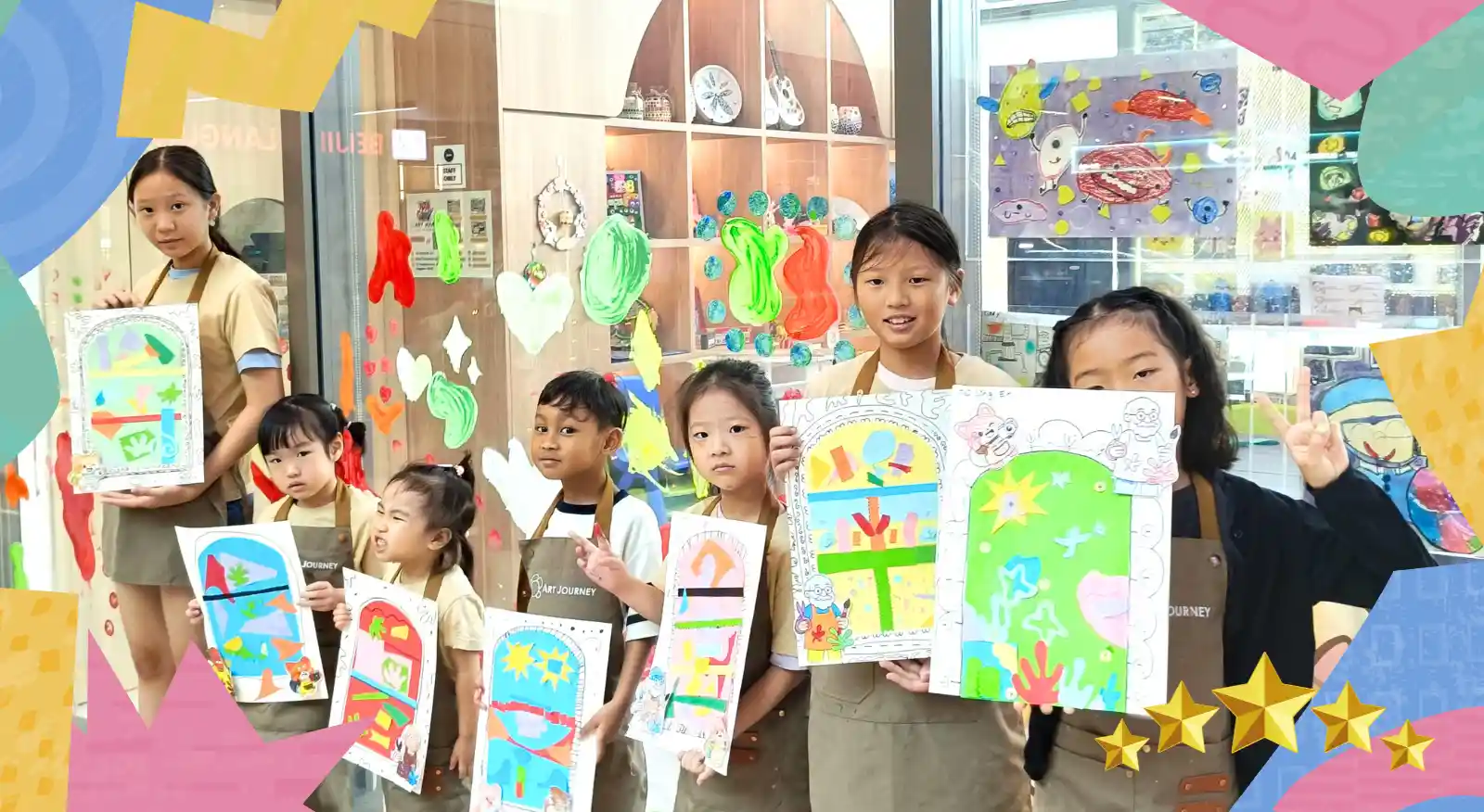
Art Journey welcomes children from age 3 — for both structured workshops and family art jamming sessions. The studio is set up for young children: child-height tables, non-toxic materials, mess-friendly environment, and instructors experienced with this age group.
For families not quite ready for a workshop, family art jamming is a great starting point — mum or dad paints alongside the child, so there's zero separation anxiety and the whole family has fun.
Once your child is settled and enjoying art, you might also find our guide on art classes for toddlers, kids and teens helpful — it covers what comes next at ages 4–7 and beyond.
Art Journey welcomes 3-year-olds for workshops and family art jamming. No term, no contract — just one session to see if your child enjoys it. Parents are welcome to stay.
Book a Trial SessionMany studios accept children from age 3 for sensory-based creative exploration. Art Journey welcomes children from age 3 for both workshops and art jamming sessions. The key is choosing a programme designed for this age group — one that's sensory-rich, short, low-pressure, and focused on exploration rather than technique. Some studios also offer parent-and-child sessions for children as young as 2.
Ideally 30 to 45 minutes. Some sessions can stretch to 60 minutes if they include transitions and variety — for example, a short story introduction followed by painting followed by a sensory activity. Anything longer than an hour is too much for most 3-year-olds. Pay attention to whether the session is paced for young attention spans.
For the first few sessions, yes — especially if your child is attending a group setting for the first time. Most good studios for this age group welcome parents during sessions. As your child settles in and builds familiarity with the environment, you can gradually step back. Some children are comfortable on their own by session two or three; others need a parent nearby for longer. Both are normal.
This is very common and doesn't mean your child isn't ready. Many 3-year-olds need time to adjust to a new environment. Clingy or tearful first sessions often resolve by the second or third visit. If your child remains distressed after a few attempts, it may simply mean they need a few more months before trying again — and that's perfectly fine.
Completely normal. At age 3, children are in the scribbling stage — their drawings are about the physical act of making marks, not representation. They may name their scribbles ("this is a cat") but the drawing won't look like one. This is healthy symbolic thinking. Recognisable drawings typically emerge between ages 4 and 5, and even then they're wonderfully abstract.
Non-toxic, washable paints, child-safe clay, large crayons, chunky brushes, sponges, and textured papers are all appropriate. Avoid sharp tools, small beads (choking hazard), and any material labelled "not for children under 3." At Art Journey, all materials provided for young children are non-toxic and age-appropriate.
Yes. Art Journey accepts children from age 3 for both workshops and art jamming sessions. The studio uses non-toxic materials, has child-height furniture, and instructors experienced with young children. Parents are welcome to stay during sessions. No term commitment is required — you can book a single session to see if your child enjoys it.
Art Journey is a creative studio in Singapore offering hands-on art workshops for children aged 3 and above, plus art jamming sessions for all ages. Located at Plantation Plaza, Jurong West. Open daily 10am – 9pm.