
















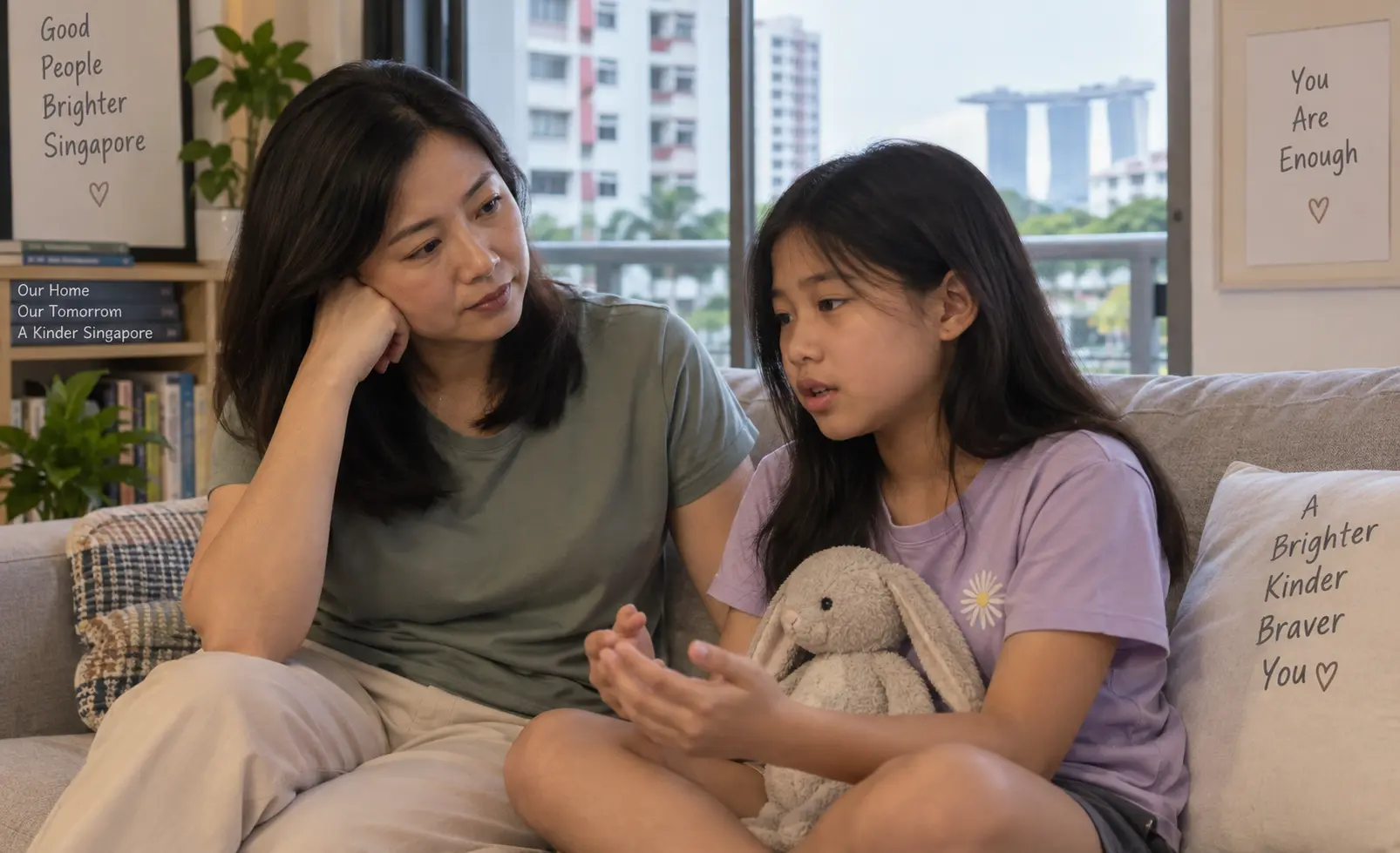
It usually arrives at a small moment. In the car after school. At the dinner table. While packing a bag for a CCA they used to like. Your child says it flatly, without drama, as though it were simply a fact they have finally worked out: "I'm not good at anything." And something in your chest drops. Because you know it isn't true, and you also know that telling them it isn't true has never once worked. This guide is about what that sentence actually means, why Singapore's environment produces it so reliably, and what to do in the ten minutes after you hear it.
"I'm not good at anything" is almost never a literal claim. Children who say it can usually name several things they do competently if you ask them directly an hour later. What they are expressing is something narrower and more specific: they have recently compared themselves to someone, come out behind, and generalised that single comparison into a verdict about their whole self.
The mechanism matters because it tells you where to intervene. The problem is not a lack of ability. It is not even, usually, a lack of confidence in general. It is the habit of measuring worth by ranking — and the fact that in a ranking, most people are not first.
The Child Mind Institute makes a useful distinction here: confidence isn't primarily about knowing you're good at something. It rests on being able to recover from setbacks and being willing to try things you might fail at. A child who has learned to define themselves by comparative position has lost access to both — because every setback becomes evidence, and every new activity becomes another opportunity to rank badly.
Comparison is universal in childhood. What differs between environments is how much of it is structural, visible, and repeated. Singapore's system has several features that make comparative self-assessment unusually easy for a child to perform, several times a day, without anyone intending it.
Class positions, banded subject levels, streamed classes, weighted assessments, cut-off points. None of these are unkind in themselves — they exist to allocate teaching appropriately. But they give a child a continuous, numerical readout of where they sit relative to everyone around them. A child does not need to be told they are twenty-third. They can work it out.
Most Singapore parents are careful never to say "why can't you be like your sister." But children do the comparison themselves, using whatever evidence is available — who gets praised at dinner, whose report card gets photographed, whose certificate goes on the fridge. A younger sibling with a high-achieving older sibling frequently arrives at "I'm not good at anything" without a single comparative remark ever having been made out loud.
Children overhear. They catch fragments of their parents' conversations about other children's tuition, results, CCA selections, and DSA outcomes. A child who hears their mother discuss another child's achievement in an admiring tone absorbs a message about what is worth admiring — and whether they qualify.
Swimming has gradings. Piano has exams. Sports have teams and reserve benches. Art has competitions. Speech has trophies. For a child who is genuinely mid-range at most things — which describes the majority of children — there is very little in their week that isn't quietly scored. The absence of a single unranked domain is the part most parents never think to check.
Put these together and you get a child who has excellent evidence for their conclusion. This is why reassurance fails. You are offering an opinion; they are holding what feels to them like data.
Every parent's instinct is to correct the statement immediately. Unfortunately, the four most natural corrections all tend to confirm the child's underlying belief rather than loosen it.
The single most useful thing to remember: the goal of the conversation is not to convince your child they are good at something. It is to loosen the link they have made between how they perform and who they are. Those are two different repairs, and only the second one lasts.
You do not need a long conversation. You need a short one that does three things: acknowledges without amplifying, narrows from global to specific, and ends without a demand.
"Was there a moment today when it felt like that?" — narrow to the specific trigger
"That makes sense that it felt bad. I'd have felt the same." — normalise the feeling, not the conclusion
"You know you don't have to be good at things for me to be glad you're mine." — separate performance from worth
"Want to just do nothing with me for a bit?" — end with presence, not a task
Notice what the sequence doesn't include: no counter-evidence, no list, no plan, no encouragement to try harder. Those may all come later, on a different day. In the first ten minutes, a child who has just said something vulnerable needs to find out that saying it didn't cost them anything.

Go through your child's weekly schedule and mark every activity that involves grading, levels, selection, competition, or comparison to peers. For most Singapore children, the honest count is "all of them." If that's the case, the most valuable change you can make isn't adding encouragement — it's adding one genuinely unranked thing. Something with no exam, no grading, no team selection, and no better-than. It doesn't have to be art. It just has to be uncompetitive.
"How did you do?" and "What did you get?" are comparison questions, even when asked warmly. They train a child to summarise their day as a score. Try substituting questions that have no ranked answer: What was the most interesting thing that happened? What made you laugh? Was there a moment you were proud of, even a small one? The shift takes about three weeks to feel natural and noticeably changes what children volunteer.
"You're so talented" and "you're so smart" are both category labels — and a child who holds a label will eventually meet someone who holds it more convincingly. Specific description survives comparison: "You spent forty minutes on that one section and didn't give up when it went wrong." That statement remains true regardless of anyone else's work, which is precisely what makes it useful.
Children draw conclusions about whether imperfection is survivable by watching adults. If every activity your child sees you do is one you're already competent at, they have no model for being a beginner. Try something you're visibly poor at, in front of them, and enjoy it anyway. This is the most underrated intervention on the list and costs nothing but a little dignity.
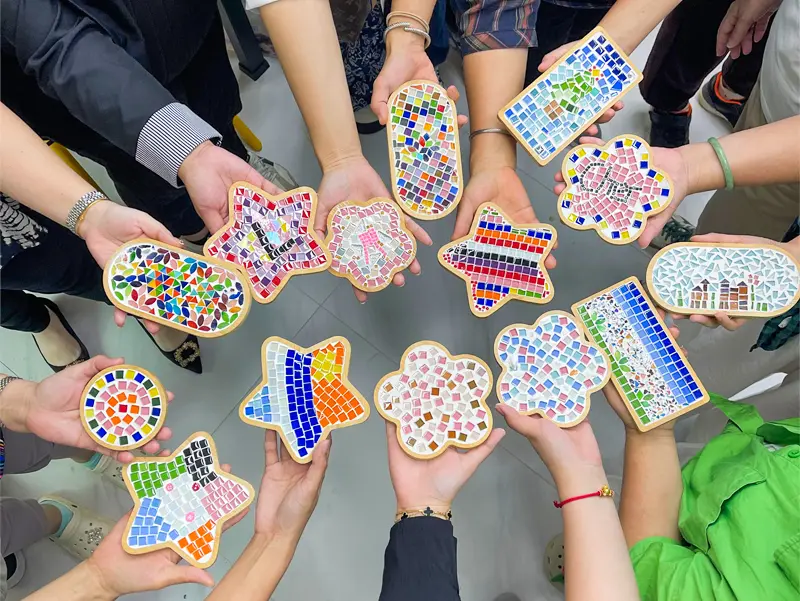
The reason creative work is useful here isn't that art is uniquely therapeutic. It's structural: open-ended creative activity is one of the few things a child can do where there is no correct answer to fall short of. A painting cannot be 14th. A clay figure has no grade band. Two children can make completely different things at the same table and both be finished.
For a child who has learned to read every activity as a test, the first session in a genuinely unranked environment is often visibly disorienting — they ask what they're supposed to make, whether it's right, whether it's good. The useful part is what happens when the answer keeps being "whatever you want" and "there's no right one." Over a few sessions, the questions stop. That change is the point.
Art Journey's workshops are built this way deliberately: no samples to copy, no marks, no comparison between children's work, and a finished piece every child takes home regardless of how it turned out. If you'd like more on how a low-pressure creative environment supports children who hold back, our related guide on how art workshops build confidence covers the studio side of it in more detail.
One practical note: if you do add a creative activity for this reason, resist the urge to turn it into another thing to be good at. Don't ask whether the teacher said their work was strong. Don't enter it into competitions yet. Don't compare this week's piece to last week's. The entire value of the activity is that it is the one place in the week where nobody is keeping score — and a parent can undo that in a single well-meant question.
Occasional self-critical comments are a normal part of growing up, particularly around exam periods or after a disappointing result. But if the pattern persists for several weeks and appears alongside other changes — withdrawing from friends or activities they used to enjoy, changes in sleep or appetite, reluctance to go to school, or statements about themselves that sound settled rather than upset — that is worth taking to someone qualified rather than managing alone.
Singapore primary and secondary schools have trained school counsellors, and a conversation with your child's form teacher is usually the simplest way to start. Your GP or a polyclinic can also refer onward. Singapore's HealthHub has practical parent guidance on children's self-esteem, and MindLine (mindline.sg) offers free, confidential support resources for families.
None of this means something is seriously wrong. It means you're paying attention to your child's inner life as carefully as you pay attention to their results — which is exactly the right instinct.
No marks, no samples to copy, no comparison between children's work. Every child leaves with something they made themselves. Art Journey welcomes children aged 4–12, by the session — no term commitment. Open daily 10am–9pm at Plantation Plaza, Singapore.
Book a SessionIt is rarely a literal statement. In most cases the child has recently compared themselves to someone specific, come out behind, and generalised that single comparison into a verdict about their whole self. The underlying issue is usually not ability or even general confidence, but the habit of measuring personal worth by comparative position — which means the useful response is to narrow the conversation to the specific triggering event rather than argue with the global claim.
Reassurance offers an opinion, while the child believes they are holding evidence — a test result, a team selection, a comparison with a sibling or classmate. Listing their achievements typically invites them to explain why each one doesn't count. A more effective approach is to acknowledge the feeling without endorsing the conclusion, then ask what specific moment prompted it.
Keep it short and do three things: acknowledge the feeling without amplifying it, narrow from the global statement to the specific trigger, and end without giving your child a task. Avoid contradicting them, listing their achievements, offering a favourable comparison, or proposing more practice — all four tend to confirm the underlying belief that worth depends on performance.
Comparison is universal in childhood, but several features of Singapore's environment make it unusually easy for children to perform comparative self-assessment repeatedly: banded and streamed classes, frequent weighted assessments, competitive tiers in most enrichment activities, and parent conversations children overhear. The result is that a child often has substantial evidence for their negative conclusion, which is why the frame itself needs addressing rather than just the individual claim.
More praise helps less than better-targeted praise. Category labels like "you're so talented" or "you're so smart" are vulnerable to comparison, because a child holding a label will eventually meet someone who seems to hold it more convincingly. Specific description survives comparison: naming what your child actually did, how long they persisted, or what choice they made remains true regardless of anyone else's performance.
It often helps considerably. Many Singapore children have no activity in their week that is free of grading, levels, selection, or peer comparison. Adding one genuinely unranked activity gives a child a different kind of evidence about themselves — that an activity can be worth doing without a score attached. It does not have to be art; it only has to be uncompetitive, and it should be protected from becoming another thing to excel at.
Occasional self-critical comments are normal, especially around exams or after disappointing results. Consider speaking to someone qualified if the pattern persists for several weeks and appears alongside other changes such as withdrawing from friends or activities, changes in sleep or appetite, reluctance to attend school, or self-statements that sound settled rather than upset. School counsellors are usually the simplest first step in Singapore, and a GP or polyclinic can refer onward. This is a sensitive area — if you are worried about your child, or about yourself, speaking to a professional early is always reasonable.