








You have a spreadsheet. You've been to five preschool tours already. You know the fees, the ratios, the curriculum type, and the distance from your HDB block. What you don't yet know — and what you might only realise nine months into the enrolment when something feels quietly off — is that most of the questions you asked at those tours were the wrong questions. Or rather, they were the obvious ones. The ones parents remember to ask two years in are the ones that actually reveal whether the preschool is right for your specific child. Here are eight of them.
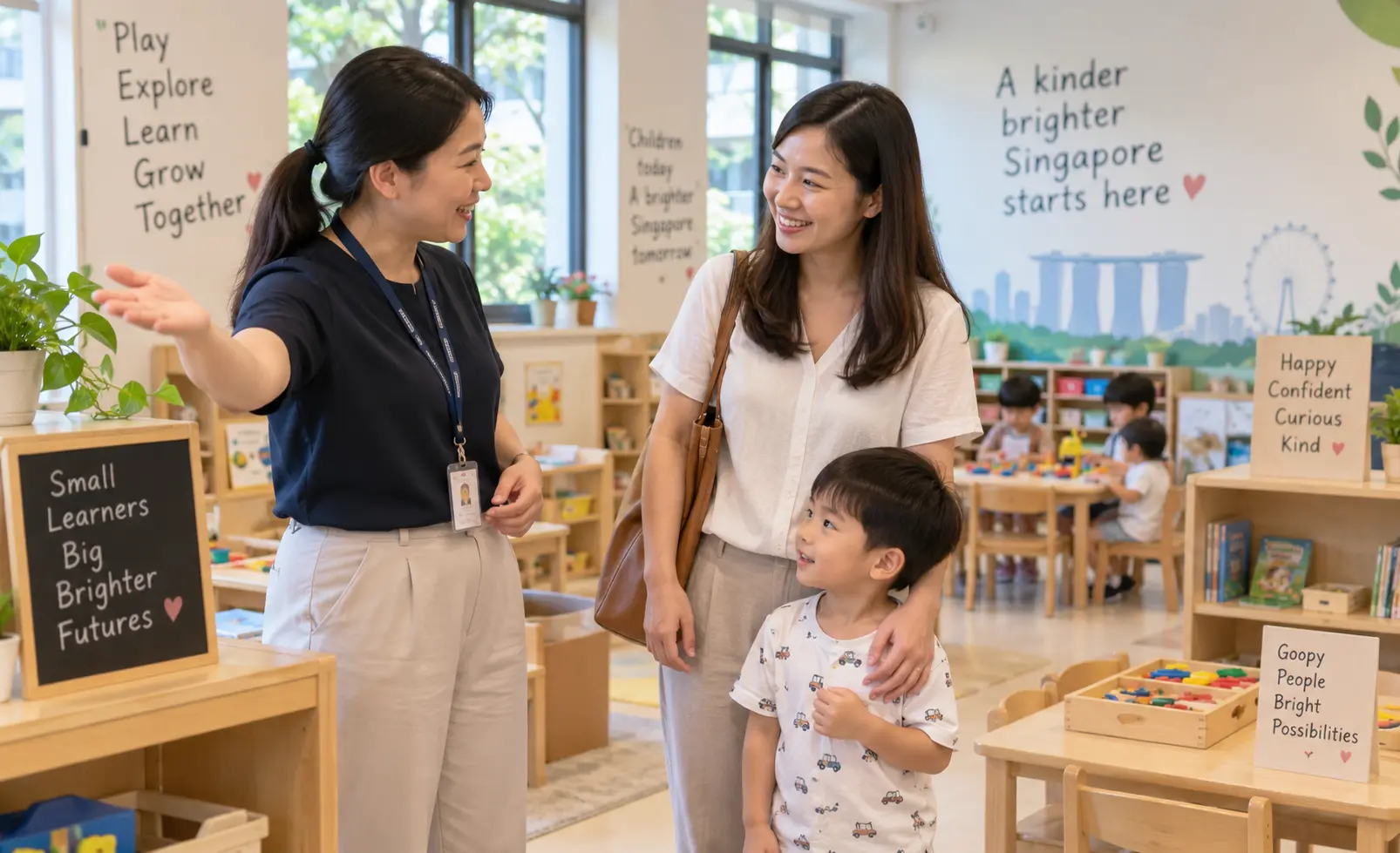
Every Singapore parent walks into a preschool tour with roughly the same list of questions. And every preschool has polished, thoughtful answers ready for them. That's not a criticism — it's just the reality of how tours are structured. The result is that most parents end up with detailed answers to the same 8-10 questions, none of which actually help them distinguish between one school and another in the way that matters most: whether their particular child will flourish there.
- What are your fees?
- What's your teacher-to-child ratio?
- Do you follow a specific curriculum?
- What are your operating hours?
- How do you handle meals and naps?
- What's your discipline policy?
- What are your safety protocols?
- How much homework will there be?
- What happens when a child cries at drop-off?
- How much of the day is truly unstructured?
- Can I visit unannounced during class hours?
- How do you talk to children about their emotions?
- What language do teachers use when a child struggles?
- What kind of parents does this school attract?
- Can I speak to alumni families?
- What happens on a really bad day for a child?
Both columns matter. The left column tells you whether the school meets the basic requirements you have. The right column tells you whether the school is the right one for the child you actually have. Most parents ask everything in the left column and none of the right. That imbalance is what leads to the "we made a mistake" feeling that emerges 6 to 9 months into an enrolment — usually too late in the Singapore preschool waitlist system to change easily.
Singapore's Early Childhood Development Agency (ECDA) is a good starting point for licensed preschool listings and quality certification — but it can't answer the specific fit questions below. Those come from asking the right things at your tour, and paying close attention to how the school responds.
How a preschool handles the earliest weeks of separation reveals almost everything about its emotional culture. Some schools have a clear, warm reunion protocol — a teacher who takes the crying child aside, sits with them, acknowledges the feeling, and stays close until they're ready to join in. Others have a more rushed approach: the child is quickly redirected, distracted with a toy, or told "no need to cry, Mummy is coming back soon." Both approaches work for some children. But they produce very different emotional experiences for the sensitive ones.
Ask specifically. Ask what a teacher would say. Ask what happens if the child cries for the whole first week. Ask what they do if the child still hasn't settled after a month.
Ask to see the actual timetable posted on the classroom wall, not the summary version on the brochure. Then count the minutes. How many are teacher-directed group activities? How many are child-directed free play? How many are transitions, meals, and routines? Preschool marketing often uses the phrase "structured play" — this can mean either genuinely open-ended play with light adult presence, or something much closer to a formal lesson dressed up in playful language. The timetable tells you which.
Research on early childhood development, including work by NAEYC's play-based learning experts, consistently shows that children in this age range benefit most from significant blocks of self-directed, imaginative play — not intensive academic instruction.
This is the single most revealing question you can ask. A confident, well-run preschool will say yes without hesitation. A school that carefully manages scheduled tours but discourages spontaneous visits is telling you something — even if they're not saying it out loud. The tour version of a preschool is always the best version. What happens on an ordinary Wednesday morning at 10am, when nobody's expecting you, is what your child will actually experience every day.
If they agree, take them up on it. Turn up quietly, walk through, and notice: are the children engaged or restless? Are the teachers warm or watching the clock? Is the noise level the sound of purposeful activity or of children barely being managed?
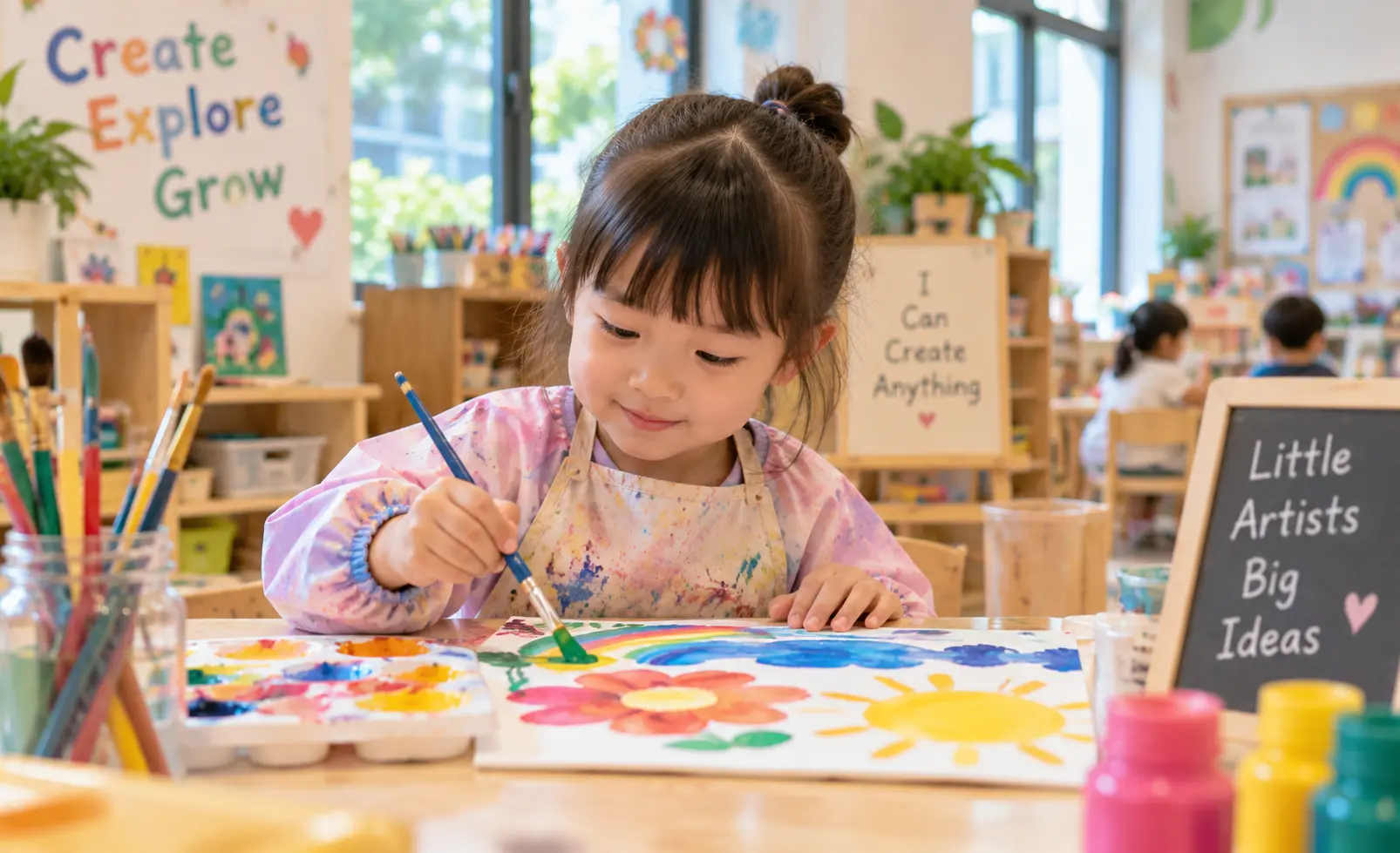
Walk through the classrooms during the tour and look at the artwork displayed. If every child's craft project looks nearly identical — same shape, same colours, same googly eyes in the same place — the children didn't really make those. The teacher did, and the children glued the final pieces on. There's nothing wrong with structured craft as an activity, but a wall full of identical output is a signal that this school's approach to creative work is product-focused rather than process-focused.
The preschools that develop genuinely confident, independent young creators are the ones where the artwork on the wall looks wildly different from child to child — different colours, different subjects, different mess levels. That variety tells you children are being trusted to make their own decisions. At Art Journey, we notice a clear difference in creative confidence between children who arrive from process-focused preschools and those who arrive from product-focused ones. The former dive in. The latter often ask "what colour should I use?" before they've even started.
Ask specifically for examples. What would a teacher say to a child who can't get their shoes on? To a child who's snatched a toy? To a child who's just spilled paint everywhere? The language teachers use in the small, everyday moments shapes children's inner voice about themselves more than any curriculum does. Some schools use language that's descriptive and specific ("I can see the paint went everywhere — let's clean it up together, then we'll try again"). Others use language that's evaluative and quick ("Aiya, so messy! Careful next time.").
Neither is inherently wrong. But the differences will shape your child's relationship with mistakes, with authority, and with themselves for years to come. This one is worth asking about explicitly, and paying close attention to the answer.
Testimonials on a website are useful; conversations with actual alumni families are essential. A confident preschool will offer to connect you with 2–3 parents whose children have already moved on to Primary 1. These are the people who can tell you what the transition to primary school actually looked like, what the emotional experience was for their child, and what they'd do differently if they were choosing again. Ask for these connections directly at the end of your tour.
Then, when you speak to those parents, ask them one specific question: "What did you not know when you enrolled that you wish you had?" The answers to that question — across two or three families — often reveal more than any brochure ever will.
Ask specifically. Not "do you have outdoor time?" — every school will say yes — but "how many minutes per day, on a typical Tuesday?" Then follow up: is that real outdoor time (grass, sky, open space) or a covered sheltered play area on the school premises? What happens if it rains? What happens during PSI-high days? Some preschools genuinely prioritise outdoor exposure. Others use "outdoor time" to mean 15 minutes on a rooftop concrete space between two air-conditioned classrooms.
Singapore's climate makes real outdoor time genuinely challenging — but the preschools that value it find ways to make it happen: shaded gardens, early-morning outdoor blocks before the heat, nearby park excursions. The ones that don't value it typically just skip it when it's inconvenient.
This one feels awkward to ask, but it matters enormously. For the next three years, you will be attending birthday parties, WhatsApp group chats, weekend playdates, and school events with these families. Your child's friends will come from this community. The parents you meet at drop-off will become a significant part of your Singapore parenting network. It's worth understanding whether that community feels like people you'd want to be around.
A good preschool director will answer this openly — describing the demographic mix, the general parenting philosophy of the families they attract, and the community feel. If the answer is defensive or vague, that's information too. The families a school attracts tells you what it values, whether it says so or not.
1. Don't ask all eight at once. Space them across the tour. Some at the start when energy is high. Some in the middle, when the tour guide has relaxed. Some at the end, when they may reveal something they wouldn't have said earlier.
2. Ask the same question at every preschool you visit. Consistency in your questions produces genuinely comparable answers. It also forces you to notice which schools give confident, specific answers vs. those that give vague, general ones.
3. Watch the classroom, not the tour guide. While the guide talks, glance at the actual children. Are they engaged? Do they seem comfortable with the teachers? Are they moving freely? Or are they sitting quietly because a tour is passing through? A five-minute observation of children behaving normally reveals more than a 45-minute presentation.
The unstated but most important test is this: when the tour ends, ask yourself whether the person leading it seemed to genuinely enjoy their job. Whether they lit up when they talked about the children. Whether they spoke about specific kids by name. Whether they described the school as somewhere they'd want their own child to be. Adults who love their work with children radiate it. Adults who see it as an administrative role radiate that too. Both are usually obvious within about ten minutes.
Preschools vary enormously in how they approach creative work. Some treat art as a scheduled 20-minute block on Fridays, focused on producing a specific take-home craft. Others weave open-ended creative activity through the entire day — a painting easel that's always accessible, a clay corner where children can go whenever they want, drawing paper freely available at all times. Both models produce children who "did art at preschool." But the children who arrive at Art Journey from open-access creative environments and those who arrive from scheduled-craft environments behave very differently on their first session.
Children from open-access preschools tend to walk in, look at the materials, pick up a brush, and start. Children from scheduled-craft environments tend to ask a series of questions first: What am I making? What colours? Is this okay? Am I doing it right? Neither group is more talented. The difference is entirely in what they've been trained to expect from creative activity.
If creative confidence and independent decision-making matter to you, one question worth asking at every preschool tour: "How much of the day are art and drawing materials freely accessible to the children?" The answer will tell you whether creativity is treated as an activity or as a way of being.
A supplementary approach some parents take: Even if your preschool has scheduled rather than open creative time, you can supplement at home and through weekend workshops. A monthly session at a studio like Art Journey, where every child works independently on their own project with real materials, is a way to give your child regular experience of self-directed creative decision-making — regardless of what their preschool structure looks like.
For more on the specific creative and developmental skills to nurture in the years before Primary 1, see our guide on 10 art skills every child should build before Primary School.
Art Journey welcomes children from age 3+ — with sessions designed around independent creative decision-making, real materials, and no product to copy. A gentle, no-commitment supplement to whatever preschool journey you're choosing. Open daily 10am–9pm at Plantation Plaza, Singapore.
Book a SessionBeyond the obvious questions about fees, ratios, and curriculum, the most revealing questions are the ones about the school's emotional culture and daily reality: how they handle a child crying at drop-off, how much of the day is genuinely unstructured, whether you can visit unannounced, what language teachers use with struggling children, and whether you can speak to alumni families. These questions reveal the day-to-day experience your child will actually have, not just the marketed version.
Yes — at least three, ideally five if your schedule allows. Visiting multiple schools does two things: it gives you real comparison points for the questions above, and it prevents you from anchoring your decision to the first attractive option. A school that seems excellent in isolation may look average once you've compared it against three others.
For children aged 3–6, research consistently shows that play-based and open-ended approaches produce stronger long-term outcomes in creativity, self-regulation, and social skills than academically intensive early programmes. That said, "play-based" is used to mean many different things by different preschools — a genuine play-based approach involves substantial blocks of child-directed activity, not just play as a delivery mechanism for lessons. Ask specifically what the daily schedule looks like.
The most reliable test is an unannounced visit during regular class hours. If the school welcomes this openly, that's a strong signal of confidence in their day-to-day operations. If they discourage or resist it, that's also information. Additionally, speaking to two or three alumni families gives you a picture of the school that no tour ever will.
Significantly. Preschools that give children open access to materials and time for self-directed creative activity produce children with visibly more creative confidence than those that treat creativity as a scheduled 20-minute craft block. Neither approach is wrong for every child, but the difference is real and observable in workshop settings later on — children from open-access preschools tend to start creating without needing instructions; children from scheduled-craft environments tend to ask what they should make first.
Popular preschools in Singapore often have waitlists of 12 to 24 months, particularly for the most sought-after infant care and toddler programmes. Realistic planning: start visits when your child is around 6–12 months old if targeting infant care, or 18–24 months if targeting Nursery 1 (N1). This gives you time to visit multiple schools, join waitlists early, and reconsider without pressure. Where can I find official information on licensed preschools in Singapore? The Early Childhood Development Agency (ECDA) maintains an official directory of licensed preschools at ecda.gov.sg, including quality certifications and inspection ratings. This is the authoritative starting point before visiting any specific school.
Location matters more than most parents initially think — a 30-minute daily commute both ways for three years adds up to hundreds of hours over the course of the enrolment, all involving a tired child and a tired parent. Unless the "best reputation" preschool is significantly better fit for your child specifically, proximity is usually the higher-value choice. A good preschool nearby will almost always outperform an excellent preschool far away.