




In many Singapore households, grandparents are present every single day — helping with school pickup, cooking dinner, watching the children after school while both parents work. Yet for all that closeness, genuinely shared activity between grandparents and grandchildren is often surprisingly thin. Homework belongs to the parents. Sports belongs to the children. Mahjong belongs to the grandparents. Television happens in the same room, but not together. What's missing is a third space — something neither generation does alone, that both can enter on equal footing. Creative activities are that space. Here is why they work, and exactly what to do.
Most activities that children enjoy involve physical energy, fast reflexes, or digital fluency — categories where grandparents are naturally at a disadvantage. Most activities that grandparents enjoy involve patience, stillness, or deep knowledge of the past — categories where young children quickly lose interest. Creative activities are one of the few formats where neither generation's advantages or limitations define the experience.
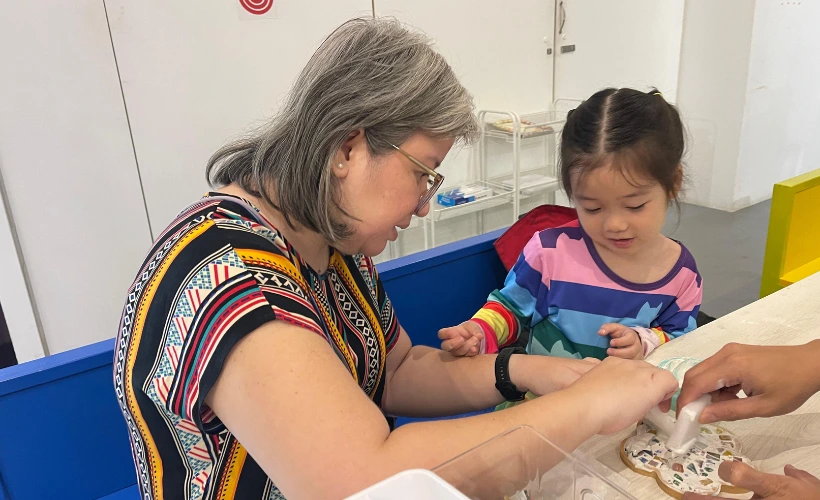
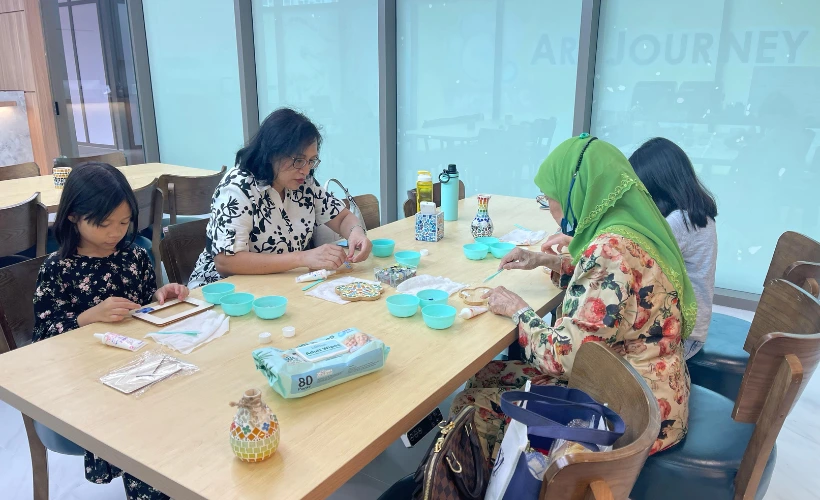
At a painting table or a mosaic station, a 68-year-old and an 8-year-old are both beginners in the same moment. Neither is grading the other. Neither is performing for the other. They're both doing something with their hands, making decisions, and occasionally looking over to see what the other has made. Research on intergenerational bonding from the American Psychological Association shows that shared, hands-on activities — where both parties are active participants rather than audience to each other — produce significantly stronger relationship quality than passive shared time like watching television.
There is also the language dimension, which matters deeply in Singapore. Many grandparents are most comfortable in Mandarin, Hokkien, Cantonese, Tamil, or Malay. Many grandchildren speak primarily English. At a dinner table, this language gap can create awkward silences and a reliance on parents to translate. At an art table, it almost disappears — because when both hands are busy making something, the natural language shifts to pointing, laughing, showing, and reacting. The work becomes the conversation.
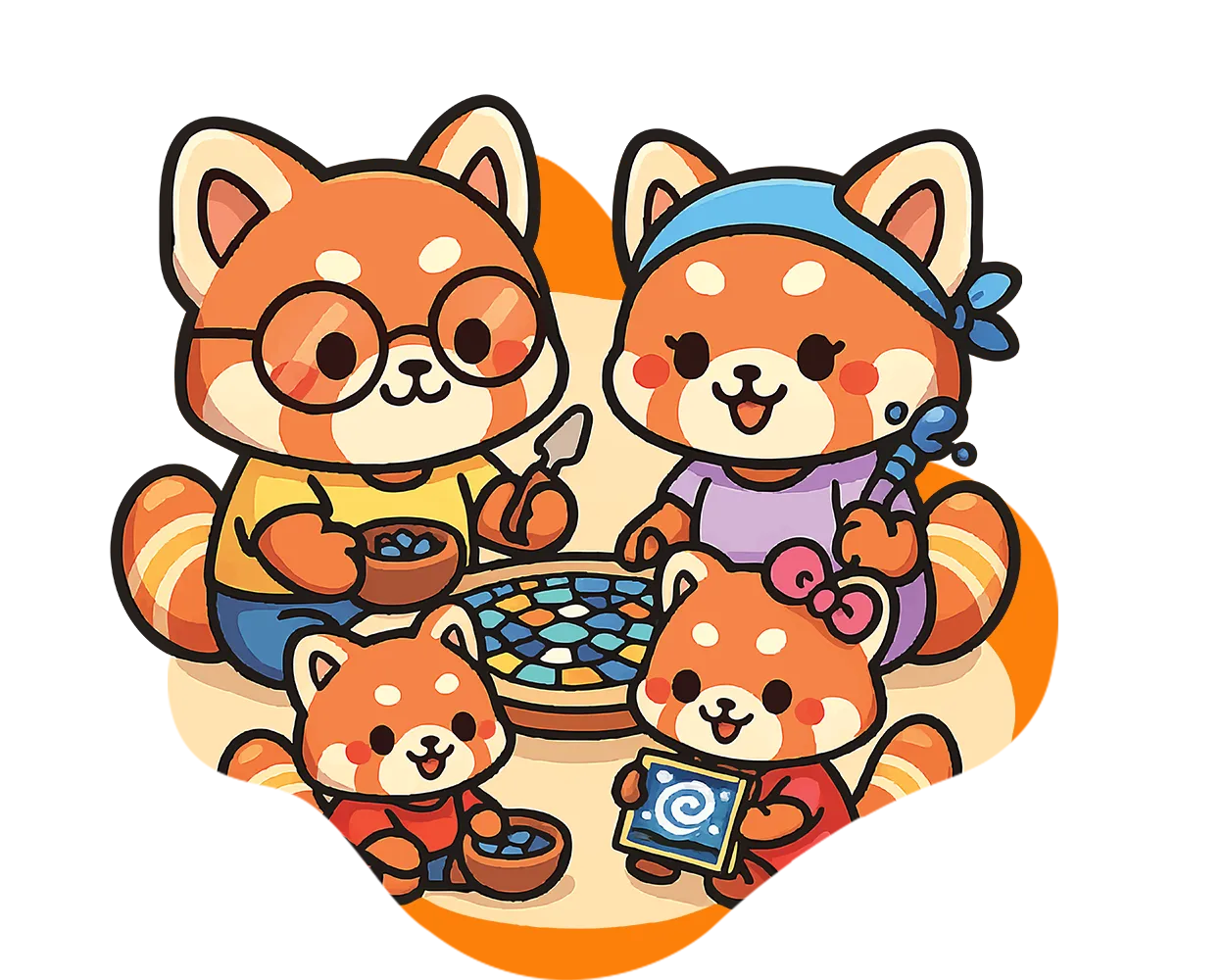
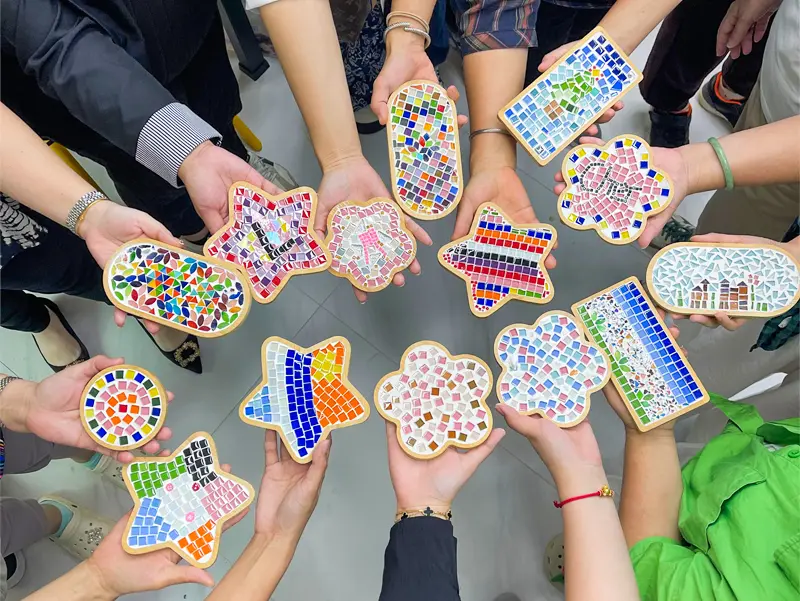
Of all the creative formats available at Art Journey, mosaic art is the one that works most consistently across the widest age range — and the one that grandparents take to most naturally. The tile-by-tile process is methodical and satisfying in a way that connects with older adults who appreciate precision and patience. For young children, the constant small decisions (which colour next, which pattern, where this tile fits) keep their attention far longer than a single broad painting stroke.
The shared table format is the key: grandparent and grandchild sit together, each working on their own coaster or tile piece, occasionally commenting on each other's colour choices, occasionally borrowing a tile from the same pile. No competition, no right answer, and both leave with something they made entirely themselves.
Give grandparent and grandchild the same starting theme — "paint what home means to you," or "paint your favourite food," or "paint something that makes you happy" — and let each work independently on their own canvas. The results are almost always charming in their contrast: the grandparent might paint a specific kampung memory or a plate of food that carries 50 years of meaning; the grandchild might paint a robot eating bubble tea. Both are right. Both are real.
Displaying both canvases together after the session — genuinely hung up, side by side, in the home — is one of the most quietly powerful things a family can do. Visitors notice. The grandparent notices every time they walk past. The child notices. It says: what this child made matters as much as what this adult made.
Nobody has an advantage with clay. A 70-year-old has never sculpted clay. A 7-year-old has never sculpted clay. Both start from zero, both make lopsided objects, both laugh at how their animals look more like potatoes than cats. Clay sculpting at Art Journey removes every generational hierarchy — there is no accumulated skill advantage, no patience requirement, and no reading or language needed. Just hands and material.
For grandparents with mild arthritis or reduced hand strength, clay is gentler than it might sound — the tactile, squeezing process is actually therapeutic for stiff joints, and working at a seated table with good lighting is entirely accessible. The results are imperfect and personal, which makes them perfect. If shaping clay feels like too much for older hands, pottery painting gives the same seated, tactile, no-skill-needed experience with less physical effort — the ceramic piece is already made, so the whole hour goes into colour and pattern, and we fire it afterwards so it lasts.
Buy or prepare a single large canvas or roll of paper and pass it around: each family member — grandparent, parent, child — contributes one section. It might be a long landscape where each person paints a portion of the horizon. Or a portrait of the family home where each person draws one room. Or an abstract piece where each person adds three brushstrokes in their favourite colour.
The finished mural is something the family made together — literally — and no single section looks like another. The grandparent's careful, deliberate marks sit alongside the child's energetic, expansive ones. The contrast is the artwork. Frame it, and it becomes a family artefact that carries an entirely different meaning from any purchased decoration.
Sand art is the format most accessible to grandparents who are new to creative activities, uncertain about their abilities, or physically limited. The peel-and-sprinkle process requires no drawing skill and no fine motor precision beyond what most older adults easily manage. Cards take 20–30 minutes each, which makes it possible to complete one together, take a break, and continue — a pace that suits both older adults and young children better than longer, sustained projects.
Making sand art festival cards together — Chinese New Year cards, Deepavali cards, birthday cards for another family member — also anchors the creative activity in something culturally meaningful, which gives the grandparent a natural opportunity to share stories about the festival, the tradition, the year they were born.
Press grandparent and grandchild hands into paint and onto the same piece of paper. The size difference alone makes the image striking — the child's small print nested inside or beside the grandparent's larger one. Add a date, a title ("Nai Nai and Xiao Ming, July 2026"), and frame it. This is almost embarrassingly simple as an art activity, but it produces something no other format does: a physical record of both people at this exact moment, together.
Grandparents who might resist coming to a studio for "an art class" will almost always agree to this at a kitchen table. It requires two pieces of card, some washable paint, and five minutes. The resulting artwork often ends up displayed in the grandparent's bedroom for decades.
Ask the grandparent to tell a story from their childhood — something real, specific, personal. The school they attended. A festival memory. A food they ate. A place that no longer exists. The grandchild illustrates the story as it's told, drawing what they imagine the scene looked like. The grandparent corrects details ("No, the bicycle was blue"), and the child adjusts. The result is a handmade illustrated page of a real memory, in the grandchild's hand, told in the grandparent's voice.
This is the most culturally rich activity on the list — and the one that produces the most conversation. Stories about pre-independence Singapore, about kampung life, about school in the 1970s, come alive when a child is drawing them. And children who have illustrated a grandparent's memory carry that memory differently than children who were simply told it.
Reframe the invitation. "Come and make something with the grandchildren" lands better than "come to an art class." Many grandparents associate "class" with performance, evaluation, and the possibility of failing. "Come and make something" is an activity, not an assessment.
Mention that no skill is required. Seriously — say it explicitly. Many older Singaporeans grew up in an era where art was a school subject with marks, not a creative experience with no wrong answers. Knowing there is no grading, no comparison, and no expectation to produce anything beautiful removes the primary barrier to participation.
Pick a seated, table-based activity. Mosaic, sand art, clay, and canvas painting all work at a table. Avoid activities that require standing for long periods, floor-based work, or sustained physical dexterity.
On the language dimension: If your grandparent is not comfortable in English, book a studio session and let the instructor know in advance. At Art Journey, sessions are structured around materials and making rather than verbal instruction — so a Mandarin-speaking grandparent and an English-speaking grandchild will spend most of the session doing rather than talking, which removes the language barrier naturally. The art is the shared language.
For more on how Art Journey supports creative activities across all age groups — including seniors — see our dedicated guide on enriching activities for seniors in Singapore.
Mosaic, clay, canvas, and sand art — all available as single sessions at Art Journey. No skill required. No term commitment. Grandparents and grandchildren welcome from ages 4 and above. Open daily 10am–9pm at Plantation Plaza, Singapore.
Book NowMosaic art, side-by-side canvas painting, clay sculpting, sand art card-making, handprint art, family murals, and story-and-illustration sessions all work well across generations. The best choices are seated, table-based, require no prior skill, and produce a finished piece both can take home. Mosaic art and sand art are particularly accessible for grandparents who are new to creative activities.
Reframe the invitation: "come and make something with the grandchildren" rather than "come to an art class." Emphasise there are no marks, no comparison, and no expectation to produce anything beautiful. Pick a format with very low skill barriers — mosaic and sand art are the best starting points, because both are peel-and-place or tile-by-tile processes that anyone can do immediately, without drawing or painting experience.
Yes. Art Journey's sessions are table-based, seated, and require no standing or sustained physical effort. All materials are provided and instructors guide participants through the process. There is no skill requirement and no time pressure. Grandparents who have never done art before are genuinely welcome — many find the mosaic and sand art formats particularly satisfying on their first visit.
Creative sessions are naturally lower-language-dependency than most activities. When both hands are busy making something, communication shifts to pointing, showing, reacting, and laughing — none of which requires a shared language. Many Mandarin or dialect-speaking grandparents who feel awkward in English-language social settings find art sessions much more comfortable, because the activity provides a shared focus that reduces pressure on verbal communication.
Art Journey welcomes children from age 4 for guided sessions. For home-based activities like handprint art and story-and-illustration, even 3-year-olds can participate with light adult support. Sand art and mosaic are appropriate from around age 5, as they involve small tile and material management that requires some fine motor control.
Television puts both in an audience position — passive, parallel, not interacting. Creative activities put both in an active, making position — where decisions are made, work is shared, and each person's choices become visible to the other. Research consistently shows that shared, hands-on activities produce significantly stronger relationship quality than shared passive time. The conversation that happens around a making activity also tends to be more genuine than conversation manufactured in front of a screen.
Yes — and the age gap is often the point. A 4-year-old and a 74-year-old at a mosaic table are both beginners. Neither has an advantage. The child's boldness with colour and the grandparent's steadiness with placement complement each other in a way that makes the shared experience feel genuinely equal. Many families report that the creative session is the first time they have seen their very young child and elderly parent genuinely engaged together as peers rather than as carer and cared-for.