
















Forty minutes of careful, absorbed work. A child who has barely looked up. And then one line goes slightly wrong — a wobble, a smudge, a letter that doesn't match the others — and the whole thing is torn in half, or scribbled over, or pushed off the table. "I did it wrong." No amount of pointing out how good the rest of it was will land. This is not a child who doesn't care. It is a child who cares so much that a single flaw has made the entire piece unbearable to look at. That distinction changes everything about what helps.

Before a perfectionist child makes anything, they have already seen it finished. There is a clear, detailed picture in their head of what the drawing, the model, the handwriting or the tower is supposed to look like. That image is vivid and it is good.
Then they start making it, with the hands and the fine motor control of a six-year-old, or a nine-year-old. And a distance opens up between the picture in their head and the thing on the table. That distance is the Gap, and the meltdown is about the Gap.
This is why reassurance bounces off. When you say "but it looks lovely," you are comparing their work to other children's work, or to your expectations. They are comparing it to the version in their head — and against that comparison, you are simply wrong. They aren't being difficult. They are being accurate about a thing you can't see.
It also explains the specific shape of the response. Children who are genuinely indifferent to an outcome shrug. Children who are experiencing the Gap grieve — and grief in a young child frequently arrives as rage, because rage is the more available emotion. Tearing up the paper is not an attack on you or on the activity. It is an attempt to make the evidence of the Gap stop existing.
The reframe that helps most parents immediately: your child is not upset that the work is bad. They are upset that they can see it isn't what they imagined. Those are completely different problems, and only one of them can be solved by praise.
Here is the part that catches parents out, and the reason many assume something has gone backwards.
As a child's skill develops, their eye develops faster than their hand. They start to notice proportion, symmetry, shading, neatness — things they genuinely could not perceive a year earlier. A five-year-old drawing a lopsided house is often perfectly happy with it. The same child at seven can see that it's lopsided, but still can't reliably draw it straight.
So the Gap widens during periods of real progress. A child who has just started noticing their own flaws is a child who is improving — but from the outside it looks like they've become harder to please, more fragile, more prone to collapse. Parents frequently describe it as "she used to love drawing and now she cries about it," and conclude the activity has become bad for her.
Usually the opposite is true. The crying is a developmental marker. It's uncomfortable, it's real, and it generally passes as the hand catches up with the eye — provided the child isn't allowed to quit the activity during the worst of it.
Perfectionist collapse doesn't always happen at the same point. Which point it happens at tells you what's driving it, and what will actually help.
The child won't begin. They need the right pencil, the right paper, a plan, more time to think. They may ask you to draw it first so they can copy. What looks like procrastination is often an attempt to guarantee the result before committing — because starting means risking the Gap.
The most dramatic version. One error, and the work in progress is torn, crumpled, scribbled out or thrown. This is the Gap becoming visible and intolerable in real time. It is almost always sudden, and the child is usually as startled by their own reaction as you are.
The piece is complete, and objectively fine, and the child refuses to keep it. They don't want it displayed, taken home, or shown to anyone. "It's ugly." This one is often the most upsetting for parents, because the work genuinely is good — and it's also the most revealing, because it shows the judgement is about the Gap rather than about quality.

Most advice about perfectionism fails because it's delivered at the wrong moment. A child in the middle of an emotional collapse has very little access to reasoning, perspective or reframing — not because they're being stubborn, but because the part of the brain that handles those things is temporarily offline. Anything you teach in that window is wasted, and attempting it usually extends the meltdown.
So separate the two windows completely, and do different jobs in each.
- Stay physically close, say very little
- Name the feeling once: "That's really frustrating"
- Don't praise the work
- Don't problem-solve or offer fixes
- Don't ask questions
- Don't require an apology for the torn paper yet
- Wait. Longer than feels comfortable
- Talk about it when you're both calm and doing something else
- Name the Gap out loud, in their words
- Show how a mistake can be absorbed into a piece
- Share a time your own work didn't match your plan
- Agree one small strategy for next time
- Address the torn paper now, briefly, without heat
The hardest part of the "during" column is how passive it feels. You are doing something important — a child who melts down and finds an adult staying calm beside them learns that big feelings don't drive people away — but it won't feel like you're helping. That's normal.
"It happens to everyone who's any good at anything. It usually means your eyes are getting better faster than your hands — which is actually a sign you're improving."
Naming the mechanism does two things: it tells the child their reaction made sense, and it gives them language for the feeling. Children who can name the Gap tend to tolerate it noticeably better.
Telling a perfectionist child that "mistakes are okay" does almost nothing. They've heard it, they don't believe it, and from inside the Gap it sounds like an adult who doesn't understand the problem. What does work — slowly, over many repetitions — is showing them that a piece of work can take a mistake and carry on.
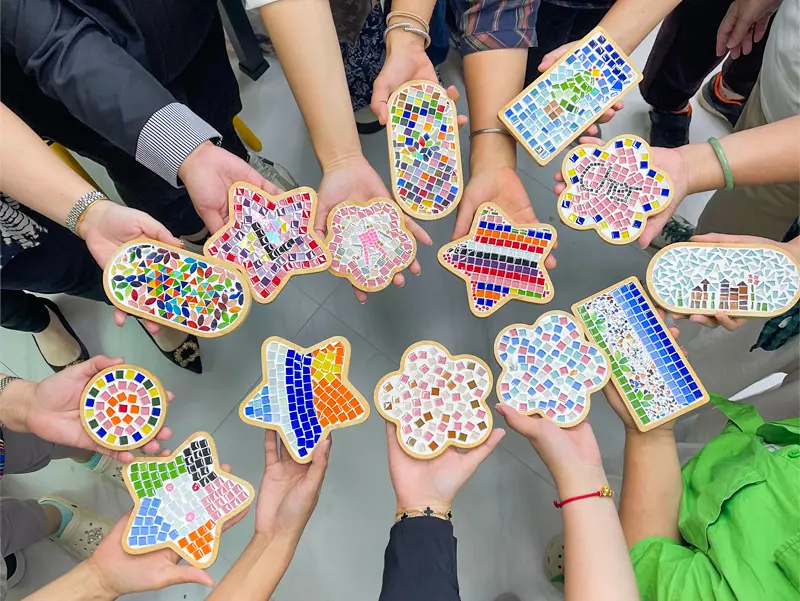
Creative materials happen to be unusually good for this, because the demonstration is physical rather than verbal. A stray line becomes a branch. A blot becomes a cloud, or a bird, or a deliberate pattern repeated three more times so it looks intended. A crooked edge on a clay pot becomes the handle. The child watches the thing they thought was ruined get absorbed into the piece.
It's worth doing this on your own work first, not theirs. Sit beside them, make something, make a visible mistake, say "oh" out loud, and then fix it into the design in front of them without any commentary about lessons. A child who watches an adult absorb a mistake calmly has seen something more persuasive than any amount of encouragement.
This is also one of the quieter arguments for open-ended creative activity over the kind with a correct answer. When there's a sample to copy, a mistake is measurable — it's a deviation from the model, and the Gap is written into the activity itself. When there's no sample, a mistake is just a thing that happened on the way to something. That's a very different emotional environment for a child who struggles here, and it's part of why our sessions at Art Journey don't use samples to copy.
Stop praising accuracy. "That's so neat!" and "it looks just like the real thing!" are the two sentences most likely to raise the stakes for a perfectionist child. You are telling them, warmly, that accuracy is what you noticed and valued. Praise the choice, the persistence, or the specific decision instead — those survive a wobbly line.
Stop fixing it for them. Taking the pencil and correcting the wonky bit resolves the immediate distress and confirms the underlying belief: that the flaw was serious, and that an adult was needed to rescue the work. Over time this also teaches the child not to attempt anything they can't do well.
Stop comparing to other children. "Look, nobody else is upset" or "your brother's is messier and he's fine" adds humiliation to frustration. It also invites a comparison the perfectionist child will almost always resolve against themselves.
Stop removing the activity. The most common parental response to repeated art-related meltdowns is to quietly stop offering art. It's understandable and it's usually a mistake — you've removed the one low-stakes arena where the child could have practised tolerating imperfection, and left only the high-stakes ones like school handwriting and tests.
Strong reactions to one's own mistakes are common in childhood, particularly between roughly five and ten, and particularly in children who are capable and self-aware. Most of it eases as children develop emotional regulation and as their hands catch up with their eyes.
It's worth speaking to someone qualified if the pattern looks different from ordinary frustration: if the reactions are frequent and intense across many settings rather than just one activity, if your child seems genuinely unable to stop once it starts rather than winding down, if they're avoiding a widening range of activities to prevent any chance of error, or if you're seeing it alongside changes in sleep, appetite, or willingness to go to school. It's also worth a conversation if the distress seems more like overwhelm than frustration — because the calm-and-wait approach above is the right tool for frustration and the wrong one for sensory or emotional overload, which needs a different kind of support.
In Singapore, your child's school counsellor is usually the simplest first step, and a GP or polyclinic can refer onward. HealthHub has practical parent guidance on children's self-esteem and emotional development. None of this means something is wrong — it means you're paying attention, which is the right instinct.
If your child's perfectionism is showing up as a settled belief about themselves rather than as in-the-moment frustration, the pattern in our guide on what to do when a child says they're not good at anything may fit better. And if it has reached the point where they're asking to stop the activity altogether, when your child wants to quit covers how to tell a temporary dip from a real one.
No samples to copy, no marking, no comparison between children's work — and instructors who are used to sitting with a child whose line went wrong. Single sessions for ages 4–12, no term commitment. Open daily 10am–9pm at Plantation Plaza, Singapore.
Book a SessionPerfectionist children usually have a clear, detailed mental image of the finished result before they begin. The distress comes from the distance between that internal picture and what their hands can currently produce — not from the work being poor. This is why reassurance like "but it looks lovely" doesn't land: you're comparing their work to other children's, while they're comparing it to the version in their head.
Often their skill is improving. A child's eye develops faster than their hand, so as they start noticing proportion, symmetry and neatness, they become able to see flaws they genuinely couldn't perceive a year earlier — while still lacking the motor control to avoid them. The gap widens during periods of real progress, which parents frequently misread as the child becoming more fragile or the activity becoming unsuitable.
Regulate, don't teach. Stay physically close, say very little, name the feeling once, and wait — longer than feels comfortable. Avoid praising the work, offering fixes, asking questions or requiring an apology in that moment. A child mid-collapse has limited access to reasoning, so anything you try to teach then is wasted and usually extends the episode. Save the conversation for hours or days later, when you're both calm.
Name the mechanism in plain language: that they had a clear picture in their head, their hands couldn't do that part yet, and that the feeling is annoying and not their fault. Adding that it usually means their eyes are improving faster than their hands reframes it as a sign of progress rather than failure. Children who have language for the feeling tend to tolerate it noticeably better.
Rarely on its own. From inside the frustration it sounds like an adult who doesn't understand the problem. What works better is demonstrating it physically — showing that a piece of work can absorb a mistake and carry on. A stray line becomes a branch; a blot becomes a cloud; a crooked edge becomes a handle. It's most effective done on your own work first, in front of them, without any commentary about lessons.
Usually not. Removing the activity takes away the lowest-stakes arena your child had for practising tolerance of imperfection, leaving only higher-stakes ones like school handwriting and tests. Open-ended creative work with no sample to copy is particularly useful here, because a mistake isn't measurable against a model — it's just something that happened on the way to something else.
Strong reactions to one's own mistakes are common between roughly five and ten and usually ease with time. Consider speaking to someone if the reactions are frequent and intense across many settings rather than one activity, if your child seems unable to stop once it starts, if they're avoiding a widening range of activities to prevent any chance of error, or if you're seeing changes in sleep, appetite or school attendance alongside it. In Singapore, the school counsellor is usually the simplest first step, and a GP or polyclinic can refer onward.