









Before anything else, the obvious disclosure: we run an art studio, and we make money when children attend. Every studio in Singapore that answers this question has the same incentive, which is why the answer you usually get is some version of "as early as possible." So here is the answer we'd give a friend rather than a customer — including the part where, for a lot of families, the honest recommendation is to wait and spend forty dollars at Daiso instead.
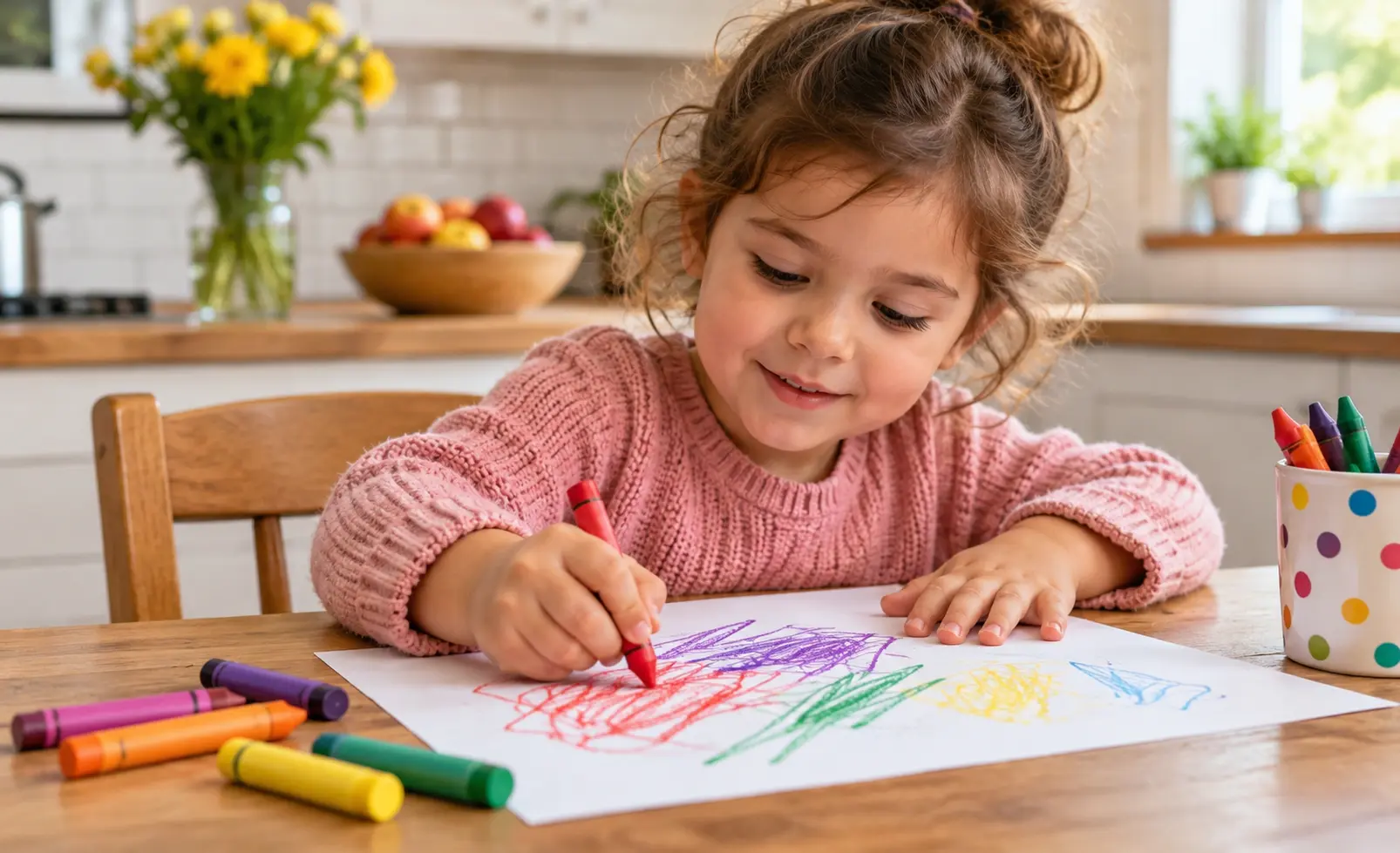
There is no developmental urgency to start a structured art class before roughly age four. Before that, what a child needs from art is available at home for very little money, and a class adds convenience and company rather than developmental benefit.
From around four, a group session starts offering things a kitchen table genuinely can't — different materials, a different adult, working alongside other children, and a sustained block of time with no household distractions. From seven or eight, a different argument kicks in, and it's the one almost nobody makes. We'll get to it.
Also: age is a weaker predictor than readiness. Two four-year-olds can be a year apart in what they'll get from the same session. The markers further down this page will tell you more than their birthday will.
Children's art develops in a recognised sequence. The framework below is the one commonly used in art education — the ages are approximate ranges and children move through them at quite different speeds, so treat them as a map rather than a timetable.
Mark-making here is largely physical rather than pictorial. A toddler isn't drawing something — they're discovering that moving an arm leaves a trace, that pressing harder changes the mark, that this colour is different from that one. It progresses from uncontrolled scribbling, to controlled scribbling once they can direct the movement, to naming scribbles ("that's a dog") usually after the fact rather than as a plan.
Somewhere in here, marks start standing for things on purpose. The classic marker is the "tadpole" person — a head with legs coming straight out of it, usually no body. This looks like a mistake and isn't; it reflects what the child considers important about a person. Drawings float around the page with no ground line, and scale follows significance rather than reality, so Mum may be larger than the house.
Children develop consistent personal symbols: their house, their tree, their way of drawing a person, repeated reliably across drawings. A baseline appears along the bottom and often a strip of sky along the top. Children frequently narrate while they draw, and the story matters as much as the picture.
Children become increasingly concerned with whether things look "right." Detail increases, proportion starts to matter to them, and — critically — they become able to see the gap between what they intended and what they produced. This is the stage where many children who loved drawing abruptly announce they're bad at it.
The standard case for starting early is that earlier means more skill. That case is weak. Fine motor development and representational drawing arrive largely on their own schedule, and a child who starts at six catches up with a child who started at three remarkably quickly.
Here's the argument we think actually holds:
Self-criticism arrives on schedule around seven to nine, whatever you do. The useful question is whether your child reaches it with an established creative habit or without one.
A child who has been making things casually for two or three years hits that stage with evidence — they've made things they liked, they've recovered from ones that went wrong, and creating is simply something they do. A child who starts at eight meets the hardest emotional phase of children's art on their very first attempt, with no track record to fall back on. The second child quits far more often.
That's a real reason to start before seven. It isn't a reason to start at two. And notice it's an argument for habit, not for classes — a child with a well-used art corner at home arrives at that stage just as well equipped as one who's been attending a studio. If you want the home version, our home art corner guide covers it.
If your child is already in that phase and struggling with it, our piece on the perfectionist child and the "I did it wrong" meltdown deals with it directly.
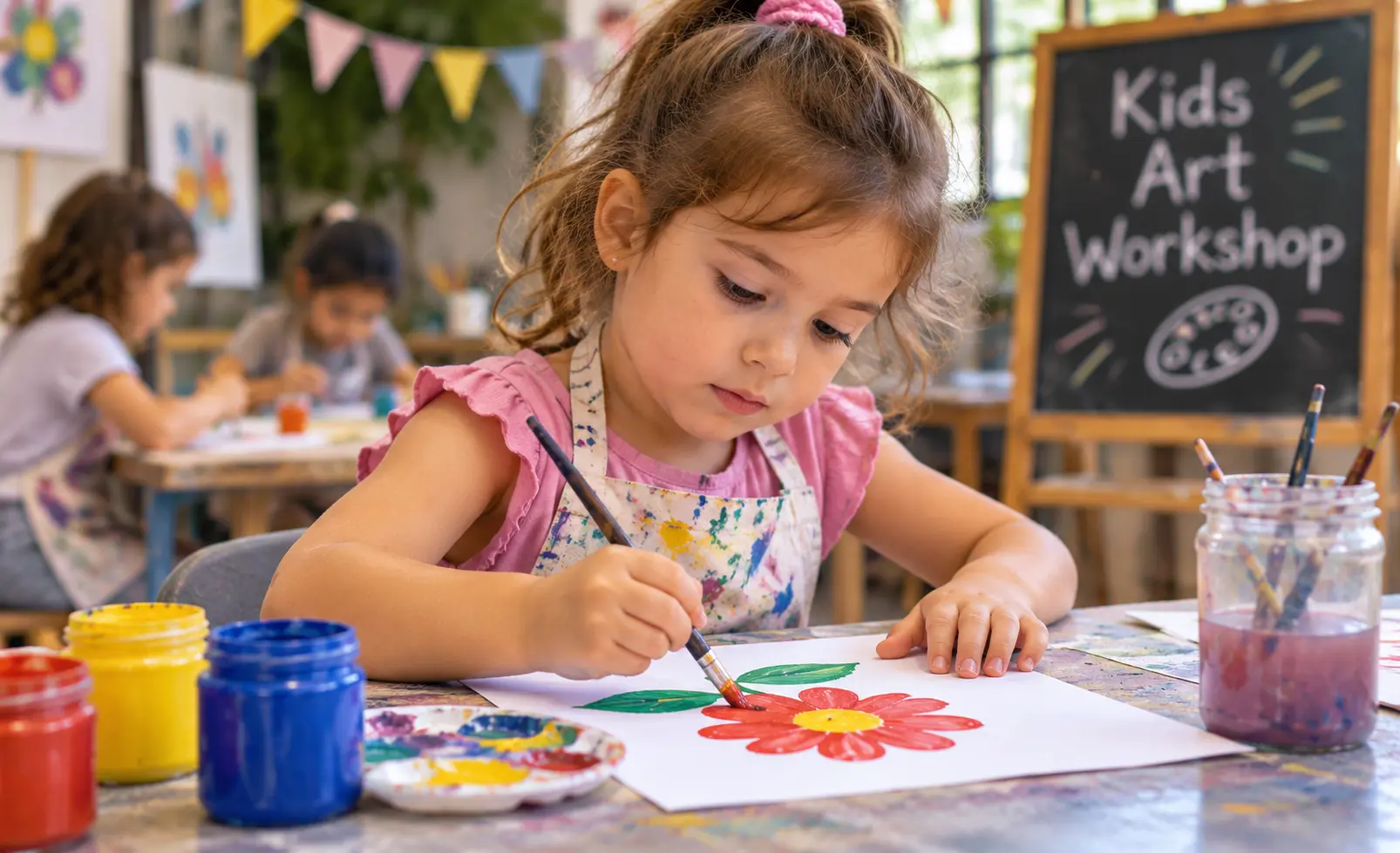
If you want a practical test, these matter more than age. A child who meets most of them will get something from a session regardless of whether they're three or six. A child who meets few will struggle even if they're "old enough."
- They no longer put materials in their mouthThis is a safety threshold, not a preference. Until it's reliably passed, close supervision at home beats a group setting.
- They can separate from you without distressFor drop-off sessions this is the real gate. If separation is still hard, look for parent-accompanied formats rather than waiting another year.
- They can stay with one activity for ten to fifteen minutesNot an hour — that develops in the session. But a child who moves on every two minutes will find a structured block frustrating rather than absorbing.
- They can follow a two-step instruction"Put your brush in the water, then pick a colour." This is what makes a guided activity possible at all.
- They tolerate mess on their handsSome children genuinely dislike it, which is worth knowing in advance. It isn't a problem — it just points toward drier formats like collage or mosaic rather than paint.
- They show some interest unpromptedReaching for crayons, drawing without being asked. If creative activity has never appealed at home, a class is unlikely to be where the interest starts.
If your child is under three and the goal is developmental. Buy paper, chunky crayons, washable paint and air-dry clay. Put them somewhere your child can reach without asking. That does the job. If you want a class for the company or the hour out of the house, that's genuinely fine — just don't let anyone tell you it's building something a home setup wouldn't.
If you're adding it to an already full week. A child doing five enrichment activities doesn't need a sixth, even a relaxed one. Something should come out before anything goes in.
If your child has firmly said no. Starting an activity over a child's objection reliably produces a child who dislikes that activity. Wait, or try a single session with no commitment attached and let them decide.
If the real aim is academic. Art workshops are not a route to better handwriting, better grades or a DSA portfolio for a six-year-old, and any studio implying otherwise is selling you something. The honest benefits are different ones.
We've written separately about what to expect at each stage, because the right session for a three-year-old looks almost nothing like the right one for a nine-year-old.
Whether three is too early, what a genuinely appropriate session looks like at that age, and the honest signs to wait: Is your 3-year-old ready for art classes?
The window where structure starts paying off — formats, session length and what to look for: Art classes for 4 to 6 year olds in Singapore
Older children, growing self-criticism, and choosing between technique-led and exploratory approaches: Art classes for primary school kids
One point that applies across all three: for a first attempt, a single session with no term commitment tells you more than any amount of reading. A child's actual response in the room settles the question faster than a readiness checklist — and if the answer turns out to be "not yet," you've lost one afternoon rather than a term's fees.
Early childhood bodies such as NAEYC are consistent that young children learn primarily through play and self-directed exploration rather than instruction — which is worth holding in mind when comparing a structured curriculum against an open-ended session. For this age group, the less instructional option is usually the better one.
Single sessions from age 4, no term commitment, materials included. If your child isn't ready, you'll know within twenty minutes and you've committed to nothing. Open daily 10am–9pm at Plantation Plaza, Singapore.
Book a Single SessionThere's no developmental urgency before roughly age four. Before that, what children need from art — frequent access to materials and permission to explore them — is available at home inexpensively, and a class adds convenience and company rather than developmental benefit. From around four, and more clearly between five and seven, group sessions start offering things a kitchen table can't: different materials, a different adult, working alongside other children, and a sustained block of uninterrupted time.
Not for skill reasons. Fine motor development and representational drawing arrive largely on their own schedule, and children starting at five or six catch up with earlier starters quickly. The stronger timing argument is different: self-criticism about artistic ability reliably emerges around seven to nine, and a child who already has an established creative habit weathers that phase far better than one starting from scratch at eight. That's a reason to begin before seven — not a reason to begin at two.
Not necessarily too young, but rarely necessary. At three, mark-making is still largely about physical discovery, and a home setup of chunky crayons, big paper and washable paint does most of what a class does. If you want a session for the social element or simply to get out of the house, that's a perfectly reasonable choice — just not a developmental one. Readiness markers matter more than age at this stage, particularly whether the child still mouths materials and whether they can separate comfortably.
Better indicators than age: they no longer put materials in their mouth, they can separate from you without distress for drop-off formats, they can stay with one activity for ten to fifteen minutes, they can follow a two-step instruction, they tolerate mess on their hands, and they show some unprompted interest in drawing or making at home. A child meeting most of these will get something from a session regardless of their exact age.
The commonly used framework runs roughly: scribbling from about 18 months to 3 years, where marks are physical discovery rather than pictures; pre-schematic from about 3 to 4, where the first deliberate representations appear, including the classic "tadpole" person; schematic from about 5 to 7, with consistent personal symbols and a baseline along the bottom of the page; and dawning realism from about 7 to 9, where concern with accuracy grows and self-criticism emerges. Ages are approximate and children move through them at different speeds.
If your child is under three and your goal is developmental, a home setup does the job for far less. If their week is already full of enrichment, something should come out before anything goes in. If they've firmly said no, starting over their objection reliably produces a child who dislikes it. And if the real aim is academic — better handwriting, grades, or a DSA portfolio for a young child — art workshops aren't that, and any studio implying otherwise is overselling.
A single session with no term commitment tells you more than any amount of research. A child's actual response in the room settles the question quickly, and if the answer is "not yet," you've lost one afternoon rather than a term's fees. It also removes the pressure that makes a first session harder for cautious children, who often agree to one afternoon when they'd refuse a commitment.